AI Chatbot Pricing for Healthcare, Real Estate, and Retail in UAE: What Decision Makers Should Budget in 2026
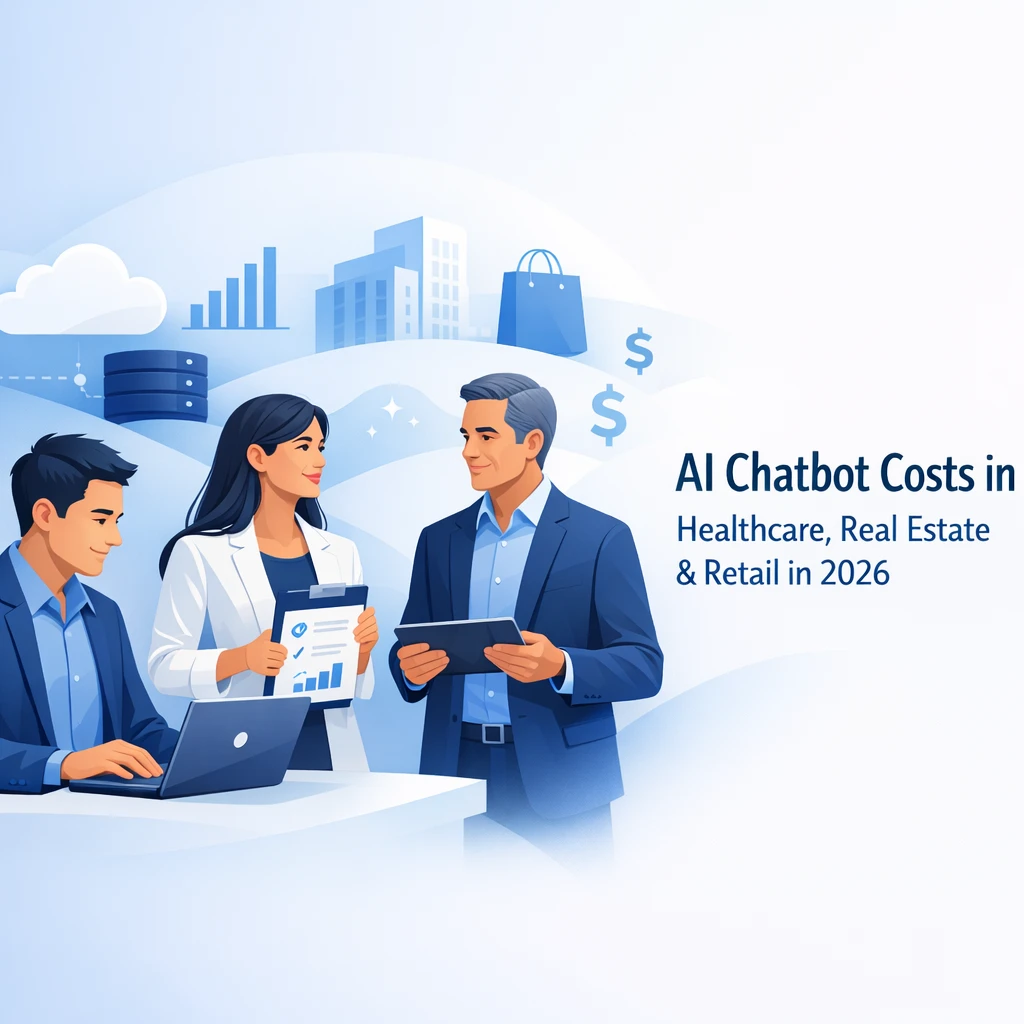
As AI-powered chatbots mature, decision makers in the UAE and across the broader GCC region face a practical question: what should we budget for an intelligent assistant that can handle healthcare scheduling, property inquiries, and retail customer support? This article helps CTOs, CEOs, product managers, and digital transformation leaders build a realistic, ROI-driven view of what pricing looks like in 2026, with a focus on healthcare, real estate, and retail in markets such as Dubai, Abu Dhabi, Riyadh, Dubai Free Zones, and beyond. We approach pricing from a practical perspective — what you get, how it scales, and how to balance build vs buy for durable results. Triostack Technologies is referenced to illustrate what a mature, global software partner brings to the table — without turning this into an advertisement.
\nThroughout this guide you will find real-world patterns, example cost bands, and implementation checkpoints designed for SMBs, SMEs, startups, and established enterprises planning software projects in the USD 5k to 200k band. We also include regional nuances, such as data privacy expectations in the UAE, Saudi Arabia, Qatar, Oman, Kuwait, Bahrain, and international delivery models that help you optimize cost without compromising quality.
\nWhat is the Topic?
\nThe topic is simple on the surface: how should an AI chatbot be priced in 2026 for industries that demand reliability, privacy, and fast ROI — specifically healthcare, real estate, and retail in the UAE and related markets? The answer depends on several layers: the scope of conversations, the required integrations (CRM, ERP, booking systems, inventory, telephony), language support, regulatory considerations, and whether you choose a build vs buy approach. This article breaks down those layers, provides concrete pricing expectations, and highlights practical implementation patterns that align with real-world budgets.
\nWhy it Matters in 2026
\nIn 2026, AI chatbots are moving from novelty tools to core customer touchpoints. For healthcare, chatbots handle appointment scheduling, triage, and patient education while complying with data privacy standards; for real estate, they streamline property inquiries, scheduling, and document collection; for retail, they power product discovery, order tracking, and post-purchase support. The UAE market, with its multilingual population, cross-border requirements, and strict regulatory environment, demands chatbots that are reliable, secure, and easy to scale. Getting pricing right matters because it affects not just the initial build, but ongoing maintenance, data security, model updates, and the ability to scale across multiple lines of business and regions.
\nKey outcomes you should expect from a well-planned chatbot program include: faster response times, improved lead conversion, better appointment adherence, higher customer satisfaction, and measurable reductions in contact center costs. Your pricing model should reflect the lifecycle of the product — from pilot to scale — and should be transparent about ongoing costs such as licensing, cloud hosting, data processing, security, and support.
\nCurrent Industry Challenges
\n- \n
- Cost control without compromising reliability — many organizations underestimate ongoing hosting, model refresh, and data privacy costs. \n
- Data privacy and compliance — UAE data protection regulations, healthcare data handling, and cross-border data transfers require careful architecture and auditable processes. \n
- Multi-language capabilities — Arabic and English (with potential additions like Urdu, Hindi, and others) demand robust NLP and localization. \n
- System integration — connecting to CRM, ERP, EHR/EMR, booking engines, and payment gateways adds complexity and cost. \n
- Time-to-value — leaders want to see measurable improvements quickly, which pushes for faster pilots and modular upgrades. \n
Understanding pricing in this context means distinguishing between upfront development, ongoing operation, and continuous improvement. It also means recognizing that a better architecture and disciplined project governance reduce total cost of ownership over time. Triostack helps clients design solutions that balance these dimensions while preserving flexibility for future AI enhancements.
\nCurrent Industry Challenges (continued)
\nBelow are practical considerations you’ll likely encounter when budgeting for AI chatbots in these sectors.
\n- \n
- Healthcare will emphasize privacy, audit trails, patient consent, and secure data handling. Expect added costs for secure hosting, encryption, and access controls. \n
- Real estate requires strong workflow for document collection, e-signatures, and calendar sync. Integrations with property listings systems can affect pricing. \n
- Retail prioritizes conversational commerce features, product catalogs, and return workflows. Multi-brand or multi-store scenarios increase complexity. \n
How the Technology Works
\nAt a high level, an AI chatbot combines NLP, a dialog manager, and integrations to deliver meaningful conversations. In healthcare, conversations must support scheduling, triage, and education; in real estate, they handle inquiries and appointment bookings; in retail, they guide discovery and order tracking. The software stack typically includes a front-end interface (web, mobile, messaging), an API layer, an NLP model or service, a dialog manager, and connectors to core systems such as CRM, ERP, EHR/EMR, inventory, and payment gateways. Security, monitoring, and governance are woven through every layer.
\nIn practice, you’ll often see a phased approach: start with a minimal viable chatbot that handles a narrow set of intents, then progressively expand capabilities, language coverage, and integrations. This staged approach helps you manage cost while proving value early.
\nArchitecture Overview
\nUse this high-level diagram to visualize core components and how data flows between them. A practical architecture balances cloud-based AI services with on-prem or private cloud connectors where needed for privacy and regulatory compliance.
\nStep-by-Step Workflow
\n- \n
- Discovery & goals alignment with stakeholders from healthcare, real estate, or retail teams. \n
- Conversation design: define intents, entities, and dialogue flows tailored to industry use cases. \n
- Data mapping: identify CRM, ERP, property listings, EHR/EMR, or product catalogs to integrate. \n
- Build & integration: implement API connectors, authentication, and data synchronization. \n
- Model selection and tuning: configure NLP capabilities, multilingual support, and domain prompts. \n
- QA & security review: run privacy, access control, and compliance checks; conduct user testing. \n
- Deployment & monitoring: release to staging and production, set up dashboards and alerts. \n
- Continuous improvement: gather user feedback, run experiments, and refine intents. \n
Business Use Cases
\nBelow are representative use cases by industry. Each example highlights what you should measure and how to scope for a 6–12 week pilot and a subsequent scale phase.
\nHealthcare — Appointment Scheduling and Triage
\nA UAE-based clinic wanted to reduce phone volume and improve patient intake accuracy. The chatbot handles appointment requests, basic triage questions, and reminders. It integrates with the clinic’s scheduling system and securely passes patient data to staff when escalation is required. Outcomes include improved appointment adherence, faster triage, and a more consistent patient experience.
\nReal Estate — Property Inquiries and Bookings
\nA regional real estate agency sought to centralize inquiries from web, social, and messaging channels. The bot presents property options, collects preferences, schedules tours, and submits pre-qualification data to the CRM. The automation reduces manual follow-ups and speeds up lead routing to agents.
\nRetail — Product Discovery and Order Tracking
\nA multi-brand retailer in the region deployed a shopping assistant that helps customers find products, answers questions about stock and delivery, and coordinates returns. The bot integrates with the catalog and order management system, enabling seamless post-purchase support.
\nIndustry Applications
\nAcross healthcare, real estate, and retail in the UAE and neighboring markets, chatbots unlock consistent customer experiences and scalable support. Multilingual capabilities, local regulations, and integration maturity drive the scope and cost of each project. When you evaluate pricing, consider not only the initial build but also ongoing hosting, model updates, security audits, and support.
\nBenefits
\n- \n
- 24/7 availability and faster response times for common inquiries. \n
- Improved lead capture, scheduling, and conversions across industries. \n
- Standardized customer journeys that reduce human error and training costs. \n
- Better data capture for analytics and personalization while preserving privacy. \n
- Scalable architecture that supports multilingual needs and future expansions. \n
Challenges
\n- \n
- Balancing automation with human touch for complex conversations. \n
- Maintaining privacy, consent, and auditability for sensitive data. \n
- Ensuring seamless integration with legacy systems and data models. \n
- Managing the cost of model updates and cloud-hosted services over time. \n
Common Mistakes
\n- \n
- Launching a chatbot without a clearly defined ROI or measurable goals. \n
- Underestimating data preparation and integration complexity. \n
- Ignoring multilingual requirements or local regulatory nuances. \n
- Inadequate change management and insufficient stakeholder alignment. \n
Best Practices
\n- \n
- Define pilot goals with specific KPIs (conversions, time-to-resolution, appointment rates). \n
- Adopt a modular design with a phased rollout to manage risk and cost. \n
- Prioritize privacy-by-design and ensure auditable data flows. \n
- Plan for language localization and cultural nuance in the UAE and GCC markets. \n
- Establish governance around data retention, access, and model updates. \n
Build vs Buy Comparison
\n| Aspect | Build | Buy |
|---|---|---|
| Time to value | Longer (custom design) | Faster (shared platform) |
| Control & customization | Highest | Moderate |
| Data privacy & compliance | Full control, but heavier effort | Depends on provider |
| Total cost of ownership | Potentially higher upfront | Predictable ongoing costs |
| Scalability | Depends on architecture | Often quicker to scale |
Estimated Development Cost
\nUse these indicative ranges as a starting point for planning. Prices vary by region, data requirements, language support, and integration complexity. The ranges assume a mid-sized, security-conscious deployment with standard integrations and a go-live window of 8–12 weeks for pilot projects.
\n| Component | Typical Range (USD) |
|---|---|
| AI Chatbot (core bot & language model) | 5k–25k |
| AI Automation (workflows, intents, business rules) | 15k–80k |
| CRM/ERP & data integrations | 10k–100k |
| Customization & localization (Arabic, English, etc.) | 5k–30k |
| QA, security, and compliance | 5k–25k |
Note: For a full-scale enterprise web app or multi-site deployment, the upper ends of ranges can extend beyond the figures above, especially when you require advanced analytics, extensive data governance, or highly specialized domain modules.
\nRecommended Technology Stack
\nThe following stack is representative of a robust, scalable, and secure approach. Your exact choices may vary by region and partner. Triostack often tailors stacks to align with your existing infrastructure and security policies.
\n- \n
- Frontend: React or Angular (Web), Kotlin/Swift (Mobile) \n
- Backend: Node.js or Java with microservices architecture \n
- AI & NLP: Hosted LLM services with domain prompts and fine-tuning \n
- Dialog Orchestration: Rasa or custom DM plus platform-native capabilities \n
- Integrations: REST/GraphQL APIs to CRM, ERP, EHR/EMR, catalog, and payment gateways \n
- Data & Analytics: Data Lake / Data Warehouse, BI dashboards \n
- Security & Compliance: IAM, SSO, encryption, activity logging, auditing \n
- DevOps: GitHub/GitLab, CI/CD, containerization, cloud hosting \n
Future Trends
\nIn 2026 and beyond, you can expect chatbots to become more capable in nuanced conversation, better at handling regulatory constraints, and more deeply integrated into business workflows. Trends to watch include:
\n- \n
- Hybrid AI models combining generative capabilities with retrieval-augmented systems for accuracy and safety. \n
- Deeper verticalization — healthcare, real estate, and retail-specific modules with domain knowledge packs. \n
- Stricter data governance and privacy-preserving techniques to meet evolving UAE and GCC standards. \n
- Edge and private cloud deployments for sensitive data processing while preserving latency and cost efficiency. \n
How Triostack Delivers Projects Globally
\nTriostack operates as a global software development partner with a focus on custom software, web and mobile development, AI development, CRM, ERP, SaaS, cloud migration, DevOps, UI/UX, API development, dedicated teams, QA, and maintenance. We emphasize clear governance, transparent communication, and outcomes over hype. Our approach blends global delivery with local market insights to ensure compliance and relevance across regions.
\nREMOTE DELIVERY
\nTriostack offers remote delivery from our engineering centers in India, designed for clients who want high-quality engineering at competitive rates while maintaining strong oversight. Key elements include:
\n- \n
- Agile project management with sprint planning and weekly demos \n
- Communication channels including Slack, Teams, Zoom, and Google Meet \n
- Issue tracking and collaboration via Jira, ClickUp, GitHub, GitLab, and Azure DevOps \n
- CI/CD pipelines, cloud staging, and rigorous QA \n
- Comprehensive documentation, security, NDA, and IP ownership protections \n
- Timezone overlap and English communication to ensure smooth collaboration \n
- Dedicated project managers and long-term support \n
Why UAE businesses outsource development to India? Cost efficiency, a large talent pool, faster hiring, flexible scaling, high-quality engineering, and strong communication are the primary drivers. Triostack structures teams to minimize risk while maximizing delivery speed and quality.
\nCase Studies
\nBelow are anonymized, realistic implementations that illustrate how chatbots are used in varied contexts. For each case, Triostack collaborated with a client to define the scope, architecture, and rollout plan. The focus is on outcomes, not on brand names or statistics.
\nCase Study 1 — Dubai-based logistics company
\nChallenge: A logistics firm needed a chatbot to handle shipment inquiries, track orders, and route complex questions to human agents during peak periods. Solution: A multilingual chatbot integrated with the order management system, live tracking data, and a customer portal. Outcome: The bot reduced repetitive inquiries and shortened average handling time for common questions, enabling agents to focus on high-impact tasks.
\nCase Study 2 — UAE healthcare clinic
\nChallenge: An outpatient clinic required appointment scheduling, triage, and automated reminders while maintaining patient privacy. Solution: A conversation design tailored to clinical workflows, secure data handling, and integration with the clinic’s scheduling and EHR/EMR systems. Outcome: Improved appointment adherence and faster triage with auditable data trails.
\nCase Study 3 — Saudi retail business
\nChallenge: A regional retailer sought a scalable assistant for product discovery, order tracking, and returns across multiple brands. Solution: A unified chatbot connected to a product catalog, order management, and payment flows; multilingual support with Arabic and English. Outcome: Streamlined shopping journeys, better customer satisfaction, and reduced contact-center load.
\nCase Study 4 — Australian startup
\nChallenge: A growing startup needed a scalable chat platform to support customer onboarding and onboarding automation. Solution: A modular chatbot with API-driven integrations to the startup’s CRM and analytics stack. Outcome: Faster onboarding, clearer user insights, and a reusable framework for future geographies.
\nPricing for SMBs and SMEs: A Practical View
\nTypical budgets for SMBs and SMEs often fall into the USD 5k–200k range for a complete AI chatbot program, including build, integration, and initial rollout. The following cost framing can serve as a practical guide when you discuss proposals with vendors like Triostack:
\n- \n
- AI Chatbot (core bot and language model): 5k–25k \n
- AI Automation (workflows, prompts, intents): 15k–80k \n
- Integrations (CRM/ERP, EHR/EMR, catalog): 10k–100k \n
- Localization & multilingual support (Arabic + English, etc.): 5k–30k \n
- Security, QA, and compliance: 5k–25k \n
Ongoing costs beyond initial deployment typically include hosting, model updates, monitoring, security audits, and support. A well-governed program with a staged rollout makes it easier to manage these ongoing costs while delivering measurable value.
\nCost Section — Detailed Ranges for SMBs
\nBelow are typical development cost bands to anchor budgeting conversations. These ranges assume a practical scope with essential integrations and a realistic go-live window for pilots.
\n| Project Type | Typical Range (USD) |
|---|---|
| Business Website | 5k–15k |
| Customer Portal | 10k–40k |
| CRM | 15k–100k |
| ERP | 40k–200k |
| AI Chatbot | 5k–25k |
| AI Automation | 15k–80k |
| SaaS MVP | 20k–80k |
| Enterprise Web App | 30k–200k |
Pricing is affected by language requirements, compliance needs, data volumes, and the number of integrations. For many UAE-based SMBs, a staged approach with a pilot in 1–2 departments followed by a scale plan is the most economical path to value.
\nFuture Trends and Your 2026 Budget Plan
\nBudgeting for 2026 means anticipating both the evolution of AI capabilities and the need for ongoing governance. Focus on: modular architecture, robust integrations, data privacy, and a plan for model updates. A practical approach is to start with a focused pilot (e.g., appointment scheduling for a healthcare clinic) and then expand to real estate inquiries and retail product discovery as ROI becomes evident.
\nRemote Delivery — How Triostack Delivers Projects Globally
\nTriostack enables remote delivery from India with a tight governance model that aligns with UAE time zones and work rhythms. We structure projects with clear milestones, weekly demos, and transparent collaboration channels. Key elements include:
\n- \n
- Agile methodologies with concise sprint planning and visible backlogs \n
- Weekly demos via Slack, Teams, or Zoom \n
- Secure file sharing and code repositories via GitHub or GitLab \n
- Issue tracking with Jira or ClickUp \n
- CI/CD pipelines, cloud staging environments, and robust QA \n
- Comprehensive documentation, NDA, and IP ownership safeguards \n
- Dedicated project managers, strict timezone overlap, and English communication \n
- Long-term support options to ensure ongoing value \n
Outsourcing to India remains attractive for UAE-based businesses due to cost efficiency, a deep talent pool, faster hiring cycles, scalable teams, high-quality engineering, and strong communication frameworks. Triostack emphasizes governance and transparency to ensure client goals stay front and center throughout the engagement.
\nWhy Businesses Choose Triostack
\nTriostack is a global software development partner with a broad portfolio — custom software, web & mobile development, AI development, CRM, ERP, SaaS, cloud migration, DevOps, UI/UX, API development, dedicated teams, QA, and maintenance. We emphasize practical outcomes, not marketing hype. Our teams work with you to design resilient architectures, implement secure integrations, and deliver measurable business value across industries and regions.
\nConclusion
\nPricing for AI chatbots in healthcare, real estate, and retail in the UAE and GCC should reflect the complete lifecycle — from inception through ongoing optimization. A practical, phased approach with thoughtful architecture, robust security, and a clear ROI plan helps decision makers budget confidently for 2026. Triostack can be a partner that translates business goals into scalable, secure software systems that evolve with your organization. If you're planning a similar software project, Triostack can help you design, build, deploy and maintain a scalable solution.
\nFrequently Asked Questions
\n- \n
- What is a realistic AI chatbot budget for a UAE SMB?
- Most SMBs begin with a pilot in the 5k–25k range for core chatbot capabilities and then scale with additional modules and integrations. Total project budgets in the 30k–150k range are common for multi-channel pilots with CRM and basic ERP integrations. \n
- What factors drive AI chatbot pricing?
- Scope of conversations, language support, data privacy requirements, number and type of integrations, hosting choices, and ongoing support costs. \n
- Build vs Buy — which is cheaper long term?
- Build offers maximum control and customization but may incur higher upfront costs and longer time-to-value; Buy accelerates deployment with predictable ongoing costs but can limit tailor-made capabilities. A phased approach often yields the best ROI. \n
- Can a chatbot comply with UAE data privacy regulations?
- Yes, when designed with privacy-by-design principles, proper data handling, and auditable workflows. This typically adds to both upfront and ongoing costs but is essential for healthcare and regulated industries. \n
For more on how we approach these decisions, explore our case studies and the detailed sections above. Subtle but timely engagement with a trusted partner reduces risk and accelerates value realization.
\n
Triostack Team
Technology Evangelist & Writer
Triostack Team is an experienced writer and technologist, exploring the intersections of AI, cloud architecture, and modern application development. Passionate about turning complex technical concepts into accessible insights.