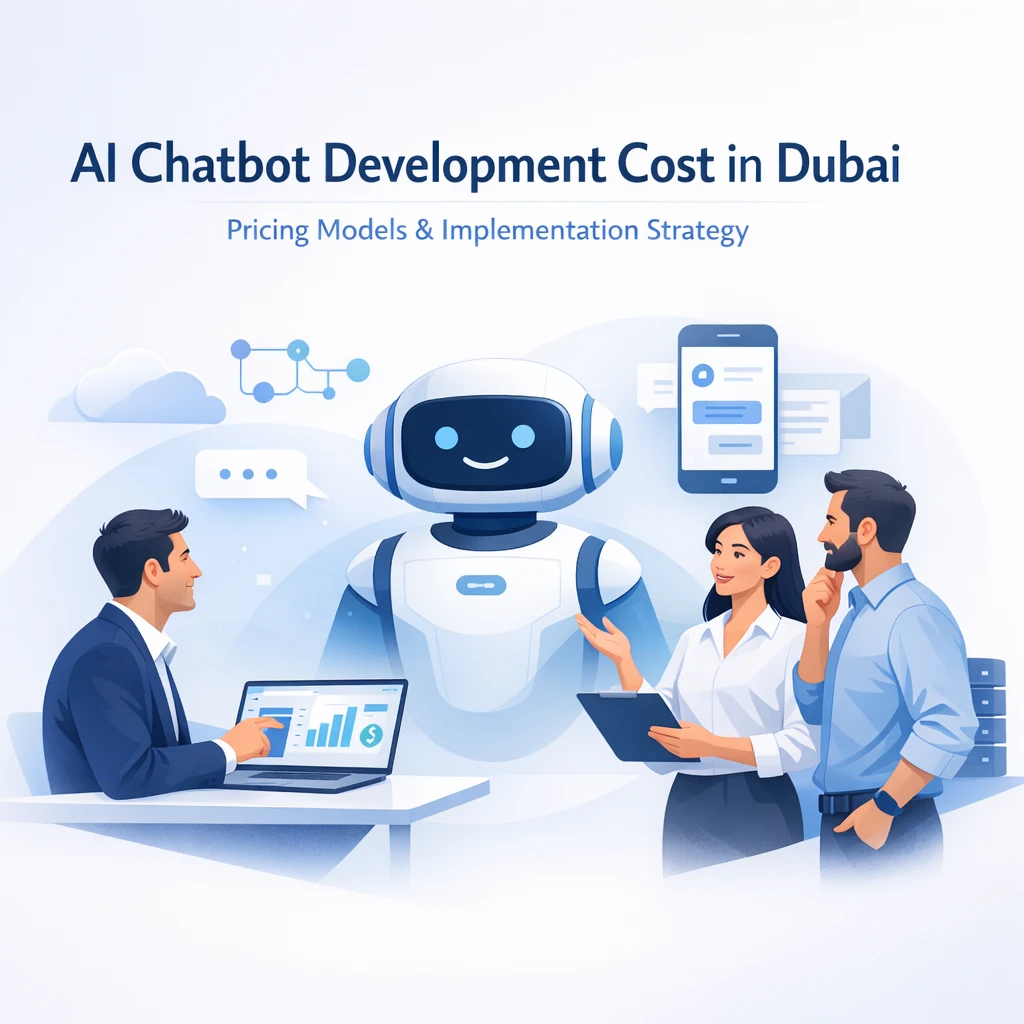
AI Chatbot Development Cost in Dubai: Pricing Models, Use Cases, and Implementation Strategy
Introduction
For many growing businesses in Dubai and across the GCC, AI-powered chatbots are no longer a novelty but a strategic tool. They promise to elevate customer experiences, streamline operations, and unlock new revenue channels. Yet, for SMBs, SMEs, startup founders, and digital transformation leaders, the big question often starts with a financial one: how much does an AI chatbot actually cost? This article provides a practical, buyer-friendly view of chatbot economics—unpacking pricing models, use cases, and a clear implementation roadmap. It also shows how Triostack Technologies can support global organizations with scalable AI, web and mobile development, and end-to-end delivery, including remote capabilities from our development hubs in India.
What is the Topic?
An AI chatbot is a software agent that interacts with users in natural language, using machine learning, NLP, and sometimes large language models (LLMs) to understand intents and generate responses. In modern deployments, chatbots do more than answer questions: they triage requests, collect context for human agents, guide users through complex workflows, and even trigger back-end processes via APIs. The cost of building such a system depends on scope, integration, data quality, model choice, deployment scale, and ongoing governance.
Why it Matters in 2026
The next wave of AI-powered conversational systems blends generative AI with structured retrieval and domain-specific knowledge. In 2026, enterprises expect chatbots to be:
- Multilingual and locale-aware for diverse markets across the UAE, GCC, Europe, and North America.
- Highly secure, compliant with regional data privacy standards, and auditable for enterprise governance.
- Seamlessly integrated with CRM, ERP, e-commerce, and service desks to reduce time-to-resolution and human workload.
- Scalable from pilot to enterprise-wide adoption with measurable ROI in customer satisfaction, lead conversion, and operational efficiency.
Current Industry Challenges
- Data fragmentation across systems (CRM, ERP, ticketing) complicates contextual understanding.
- Balancing automation with human empathy in customer interactions.
- Maintaining multilingual capabilities for diverse markets (Arabic, English, Hindi, Urdu, etc.).
- Ensuring data privacy, security, and compliance in regulated regions.
- Choosing between build and buy, and managing ongoing maintenance costs.
How the Technology Works
At a high level, a modern AI chatbot stack combines:
- Natural Language Processing (NLP) and intent recognition to understand user input.
- Generative and retrieval-based models to craft responses and fetch context from knowledge bases.
- Back-end integrations via APIs to CRM, ERP, order management, or support desks.
- Dialog management to handle multi-turn conversations, context switching, and escalation to human agents.
- Data governance, monitoring, and analytics to improve the model over time.
Key decisions include whether to use a hosted LLM (with fine-tuning or prompt engineering) or to adopt a hybrid approach that combines a retrieval-augmented generation (RAG) model with domain-specific databases and decision trees.
Architecture Overview
A typical enterprise chatbot architecture comprises:
- Frontend: web, mobile, or in-app chat UI
- Orchestration layer: dialog manager and routing
- NLP/LLM layer: intent detection, generation, and knowledge retrieval
- Integration layer: APIs to CRM, ERP, ticketing, databases
- Data & security: access control, encryption, monitoring
For teams exploring cloud-hosted solutions, the diagram above maps to a scalable implementation where the chatbot continuously learns from interactions while maintaining guardrails and governance. Case studies illustrate how this translates into real-world outcomes.
Step-by-Step Workflow
Each project typically follows these phases with strong stakeholder alignment and clear success criteria. The workflow balances rapid MVP delivery with iterative refinement based on user feedback and performance metrics.
Business Use Cases
While every business has unique needs, these use cases frequently deliver tangible value for Dubai-based and GCC companies, as well as global teams:
- Customer support: 24/7 triage, fast routing to agents, and reduced resolution times.
- Lead generation and qualification: conversational capture of interest, enrichment, and handoff to sales.
- Booking and scheduling: appointment setting, reminders, and rescheduling via chat interfaces.
- Order status and fulfillment: proactive updates, tracking, and issue resolution.
- HR and IT helpdesk: employee onboarding, policy references, and incident triage.
Industry Applications
Across industries, chatbot deployments align with sector-specific workflows:
- Logistics: shipment tracking, customs guidance, and warehouse coordination.
- Healthcare: patient intake, appointment scheduling, and triage under clinician oversight.
- Retail: product recommendations, cart assistance, and post-purchase support.
- Financial services: balance inquiries, policy clarifications, and fraud alerts (with compliance controls).
Benefits
- Faster response times and higher first-contact resolution.
- Operational efficiency by offloading repetitive tasks from human agents.
- Scalability to handle seasonal demand and growth without proportional headcount increases.
- Improved data collection and insights through structured conversations.
Challenges
- Data quality and representation: poor training data can limit accuracy and usefulness.
- Maintaining natural, culturally aware interactions across markets (Arabic-English bilingual support, etc.).
- Security, privacy, and regulatory compliance in multi-jurisdiction deployments.
- Managing ongoing maintenance, model drift, and updates without disrupting users.
Common Mistakes
- Underestimating data preparation and integration effort.
- Over-reliance on generic LLMs without domain tailoring and guardrails.
- Skipping governance: lacking audit trails, versioning, and access controls.
- Neglecting multilingual support or cultural nuances early in the project.
Best Practices
- Begin with a clear business objective and measurable success metrics.
- Adopt a hybrid approach: leverage retrieval-based content for accuracy with generative capabilities for conversation flow.
- Design for escalation: seamless handover to human agents when confidence is low.
- Implement robust security, privacy, and data governance from day one.
Build vs Buy: A Quick Comparison
| Aspect | Build | Buy (SaaS/Managed) |
|---|---|---|
| Control over features | Maximum control; tailor to exact workflows | Limited to vendor roadmap; faster time-to-value |
| Timeline | Longer upfront; phased milestones | Typically faster to initial deployment |
| Cost predictability | Capex heavy; ongoing maintenance | Opex; predictable monthly/annual fees |
| Security & compliance | Full internal control; requires own policies | Vendor-managed security controls; some gaps may exist |
| Innovation velocity | Depends on your team capacity | Vendor-driven updates and integrations |
Estimated Development Cost
SMBs planning software projects with budgets in the range of USD 5,000 to USD 200,000 should consider a spectrum of solution types. The table below provides typical SMB ranges to set expectations and guide scoping conversations. Actual costs vary by scope, data prerequisites, integrations, and quality targets.
| Solution Type | Typical Range (USD) | Notes |
|---|---|---|
| Business Website | 5,000 – 15,000 | Content, design, CMS, basic analytics |
| Customer Portal | 10,000 – 40,000 | Authentication, self-service, integrations |
| CRM | 15,000 – 100,000 | Sales/campaign flows, automation, dashboards |
| ERP | 40,000 – 200,000 | Core processes, multi-module integration |
| AI Chatbot | 5,000 – 25,000 | NLU/Dialogue, basic integrations |
| AI Automation | 15,000 – 80,000 | RPA-like automation with NLP |
| SaaS MVP | 20,000 – 80,000 | Core feature set with cloud hosting |
| Enterprise Web App | 30,000 – 200,000 | Complex logic, APIs, integrations |
Pricing factors include: scope of features, number of integrations, data quality and migration needs, multilingual requirements, security/compliance, hosting model, and ongoing maintenance. For many clients, the most impactful variable is the breadth of integrations with existing systems and the level of customization required for conversational flows.
Recommended Technology Stack
Triostack follows a pragmatic, vendor-agnostic approach tailored to business objectives. A typical stack for a Dubai-based AI chatbot project might include:
- Frontend: React or Vue.js, responsive design, accessibility-friendly UI
- Backend: Node.js, Python (FastAPI), or .NET, RESTful APIs
- NLP/AI: Retrieval-augmented generation (RAG), fine-tuned domain models, open-source NLP libraries, or managed LLM services
- Data & Integrations: REST/GraphQL, connectors for CRM (Salesforce, HubSpot), ERP, ticketing (Zendesk), and databases
- Security & Compliance: OAuth2.0, SAML, encryption at rest/in transit, audit trails
- DevOps & CI/CD: GitHub/GitLab, Jira/ClickUp, Azure DevOps, CI/CD pipelines, automated testing
Triostack emphasizes modular, reusable components, enabling faster iteration while maintaining quality and security.
Future Trends
- Advanced multilingual capabilities and cross-language retrievals to serve diverse markets.
- Stronger governance, with model cards, explainability, and auditability in regulated sectors.
- Smarter escalation to human agents via context-aware routing and hybrid AI-human workflows.
- Deeper analytics: conversational KPIs, sentiment, and agent-assisted learning loops.
Remote Delivery: How Triostack Delivers Projects Globally (From India)
Triostack leverages a globally distributed delivery model that combines cost efficiency with high-quality engineering. From our India delivery centers, we support EU, GCC, US, UK, and APAC clients through fully remote engagements. This approach enables access to a large, diverse talent pool while maintaining rigorous project governance and security standards.
What this means in practice
- Agile with well-defined sprints and backlog management.
- Sprint Planning and Weekly Demos to ensure transparency and alignment.
- Communication channels: Slack, Teams, Zoom, and Google Meet for daily interaction.
- Project management: Jira, ClickUp, GitHub, GitLab, or Azure DevOps for issue tracking and collaboration.
- CI/CD pipelines with cloud staging and automated testing to accelerate release cycles.
- QA and Documentation as continuous processes; security, NDAs, and IP ownership protections are standard.
- Time zone overlap strategies to ensure meaningful daily communication and timely feedback loops.
- Dedicated Project Managers to coordinate across teams and maintain milestones, risk registers, and change logs.
Why UAE businesses outsource development to India
- Cost efficiency without compromising quality through scalable teams and flexible resource models.
- Access to a large talent pool with deep experience in AI, cloud, web and mobile development.
- Faster hiring and ramp-up, enabling rapid pilots and controlled scaling.
- Strong communication practices and mature engineering standards support international collaborations.
Triostack ensures legal and security protections, including non-disclosure agreements (NDAs) and clear IP ownership terms, so UAE and GCC clients can outsource with confidence while maintaining compliance with local data-protection requirements.
Case Studies (Realistic Scenarios)
Case Study 1: Dubai-based logistics company
A Dubai-based logistics firm sought an AI chatbot to handle customer inquiries about shipments, delivery windows, and documentation. The project integrated with the company’s existing order management and CRM. Key outcomes included improved first-response times, reduced call volume to contact centers by 25% within three months, and a 15% uplift in on-time delivery notifications inferred from proactive updates. The bot supported Arabic and English, with a fallback workflow to human agents when complex exceptions arose.
Case Study 2: UAE healthcare clinic
A regional healthcare clinic implemented an AI chatbot to triage patient symptoms, schedule appointments, and provide pre-visit instructions. The solution connected to the clinic’s appointment system and patient records while ensuring compliance with healthcare data privacy requirements. Benefits included 24/7 triage capability, improved appointment adherence, and reduced administrative workload for staff.
Case Study 3: Saudi retail business
A Saudi retailer deployed a multilingual shopping assistant to guide customers through product discovery, comparisons, and order placement. The chatbot integrated with the retailer’s e-commerce platform, inventory system, and loyalty program. Outcomes included higher cart completion rates and enriched customer insights for merchandising decisions.
Case Study 4: UK SaaS company
A UK-based SaaS company built an AI-powered onboarding coach to guide new customers through product setup, feature discovery, and help center navigation. The project emphasized strong documentation, secure data handling, and a clear escalation path to human support when needed. The result was increased trial-to-paid conversion and faster time-to-value for customers onboarding the software.
These cases illustrate how Triostack applies a practical, outcome-focused approach to AI chatbot development across regions and verticals, including the UAE, GCC, Europe, and North America.
Pricing Factors in Practice
To translate cost into value, consider these core factors when budgeting for an AI chatbot project:
- Scope and complexity: number of intents, entities, and dialog flows; whether the bot handles service desk automation or sales enablement.
- Integrations: the number and complexity of integrations with CRM, ERP, order systems, ticketing, and data sources.
- Language and cultural localization: multilingual support, tone, and locale-specific data handling.
- Data preparation: data collection, cleaning, labeling, and privacy-preserving techniques.
- Security & compliance: access controls, encryption, audit trails, and regional regulatory alignment.
- Hosting model: on-premises, private cloud, public cloud, or hybrid; considerations for latency and sovereignty.
- Ongoing maintenance: model updates, monitoring, logging, and continuous improvement cycles.
By framing the project in terms of these factors, businesses can align expectations with realistic cost trajectories and governance requirements.
Frequently Asked Questions
- What is the typical budget range for an AI chatbot project in Dubai?
- For a solid MVP with core integrations, you might budget in the USD 20k–60k range. A fully integrated, multilingual enterprise chatbot with deeper ERP/CRM integrations can range from USD 80k to USD 200k or more, depending on scope and governance needs.
- How long does it take to build an AI chatbot?
- Time to value varies, but many SMB projects start with a 6–12 week MVP, followed by iterative sprints of 4–8 weeks to expand capabilities and integrations.
- Can a chatbot operate across languages like Arabic and English?
- Yes, multilingual capabilities are common; successful deployments require careful data preparation and localization for each language region.
- Is outsourcing to India suitable for UAE-based projects?
- Outsourcing to India offers cost efficiency and access to a large talent pool, with strong governance, security, and communication practices to ensure alignment with UAE and GCC standards.
Conclusion
AI chatbot development costs in Dubai and the broader Middle East reflect a mix of technology choices, integration depth, data quality, and governance. While the price tag varies, the strategic value—improved customer experiences, faster time-to-value, and scalable operations—often justifies the investment. By starting with clear objectives, choosing the right architecture, and partnering with a trusted software development partner, organizations can unlock meaningful business outcomes while maintaining tight control over budget, security, and compliance.
Triostack Technologies offers a pathway to scalable, secure, and maintainable AI chatbot solutions with a global delivery model. If you’re planning a similar software project, Triostack can help you design, build, deploy, and maintain a scalable solution that fits your industry, market, and regulatory context.
Triostack Team
Technology Evangelist & Writer
Triostack Team is an experienced writer and technologist, exploring the intersections of AI, cloud architecture, and modern application development. Passionate about turning complex technical concepts into accessible insights.