AI Agents for Customer Support and Operations: Implementation Costs, Use Cases, and ROI for GCC Businesses
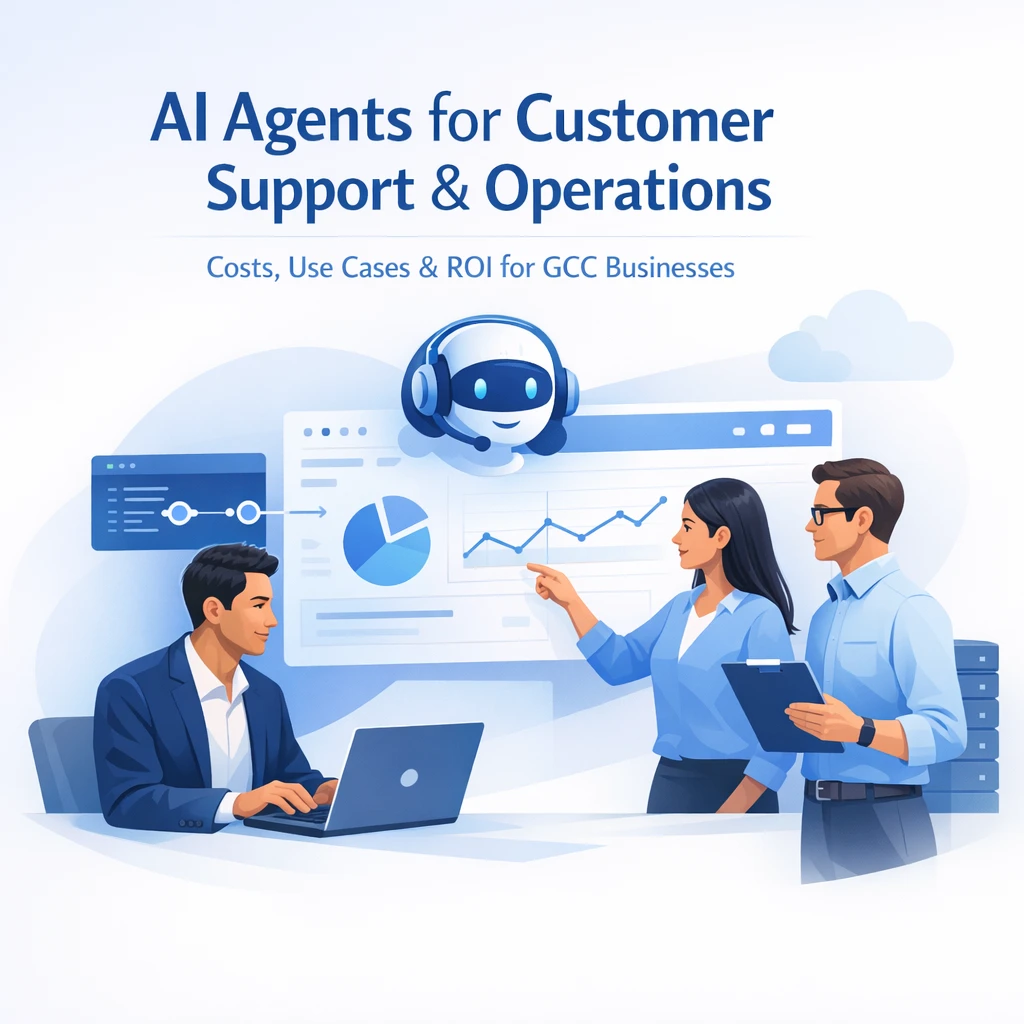
In an era where customer expectations rise as quickly as data volumes grow, GCC and global businesses are turning to AI agents to augment human agents, streamline operations, and drive measurable results. This article offers a practical, supplier-agnostic view of how to plan, build, and scale AI agents for customer support and operations. We share real-world guidance, typical cost ranges, and a framework you can reuse when engaging with a partner like Triostack Technologies.
Introduction
AI agents—also called autonomous agents or intelligent assistants—are software systems that “think and act” on your behalf across channels such as chat, voice, email, and enterprise apps. They combine large language models (LLMs) with structured rules, automation workflows, and integration layers to understand intent, access data, perform actions, and hand off to humans when needed. For GCC markets and global growth-focused businesses, these agents promise faster response times, 24/7 availability, improved accuracy, and a clearer path to scale without a linear rise in headcount.
This article emphasizes practical strategies, implementation considerations, and ROI signals. It also frames how Triostack Technologies approaches AI development—delivering outcomes through a blend of custom software, web and mobile apps, AI development, CRM/ERP integrations, SaaS, and cloud and DevOps practices—while prioritizing governance, security, and long-term support.
What is AI for Customer Support and Operations?
AI agents blend conversational AI, automation, and integrations to perform tasks that traditionally required people. They can:
- Answer customer inquiries across chat, voice, and email channels.
- Pull data from CRM, ERP, and data warehouses to resolve issues or provide personalized recommendations.
- Create tickets, update records, and trigger downstream workflows in ERP or procurement systems.
- Route complex queries to human agents with context to reduce handling time.
- Automate routine operations such as order status updates, invoice inquiries, scheduling, and escalations.
Rather than replacing humans, AI agents act as copilots—handling repetitive work and surfacing insights so agents can focus on higher‑value activities. In practice, this means faster resolutions, better consistency, and more scalable customer operations.
Why it Matters in 2026
Across the GCC and beyond, the business case for AI agents strengthens as organizations confront rising customer expectations, tighter budgets, and a shrinking talent pool for specialized support roles. Key macro drivers include:
- Multi-channel omnichannel support: Consistent, agent-assisted experiences across chat, voice, social, and email.
- Operational efficiency: Automating repetitive tasks frees up human workers for higher‑value activities.
- Data-driven decisions: AI agents surface actionable insights from CRM/ERP and analytics platforms.
- Global delivery with local nuances: AI agents can be tuned to regional language, timing, and business rules, enabling scalable regional support.
- Compliance and security: Centralized governance and auditable workflows help meet data privacy and industry standards.
For startups and growing businesses in markets like Dubai, Abu Dhabi, Riyadh, Jeddah, Doha, Muscat, and AH regions, the right AI strategy accelerates time-to-value while controlling cost and risk.
Current Industry Challenges
Many organizations grapple with data fragmentation and legacy systems that hinder fast automation. Common obstacles include:
- Disparate data sources across CRM, ERP, WMS, and legacy databases, creating data silos.
- Disconnected channels leading to inconsistent customer experiences.
- Complex integration requirements and vendor lock-in concerns.
- Security, privacy, and regulatory compliance across regions (GDPR-like regimes, local data sovereignty rules).
- Difficulty measuring ROI due to diffuse metrics and evolving KPIs.
- Talent shortages in AI expertise and software engineering, particularly for global teams.
Strategic implementation—beginning with a clearly scoped pilot, robust governance, and a plan for data interoperability—helps organizations de-risk automation projects and build a solid ROI foundation.
How the Technology Works
AI agents sit at the intersection of language AI, automation, and system integrations. A practical architecture typically includes:
- Conversational layer: LLMs and prompt orchestration to understand user intent and generate responses.
- Memory and context: Context stores and retrieval to maintain state across conversations and sessions.
- Decision and action layer: Orchestrators that decide when to fetch data, update systems, or escalate to humans.
- Integration layer: APIs to CRM, ERP, order management, helpdesk, HR systems, and data warehouses.
- Observability and governance: Logging, metrics, security, access control, and compliance controls.
When aligned with business goals, AI agents reduce cycle times, improve data accuracy, and extend coverage to peak demand periods—without a linear increase in headcount.
Architecture Overview
Below is a high‑level architecture illustrating how AI agents connect customer channels, business systems, and analytics. This model is deliberately pragmatic: it emphasizes governance, security, and incremental delivery.
Step-by-Step Workflow
A typical AI agent project proceeds through these stages. Each step emphasizes measurable milestones and risk controls.
- Discovery and scoping: Define business objectives, success metrics, and pilot scope. Create data access and security plans.
- Data and integration design: Map data sources, establish data contracts, and design APIs to connect CRM, ERP, order systems, and ITSM tools.
- Architecture and governance: Define model governance, access controls, and privacy safeguards for regional compliance.
- Prototype and pilot: Build a minimal viable AI agent for a high-impact use case and validate with real users.
- Scale and optimize: Expand use cases, optimize prompts, refine data flows, and implement monitoring dashboards.
- Operate and evolve: Establish SLAs, CI/CD for AI artifacts, and ongoing model governance as data drifts occur.
Each phase yields concrete metrics—cycle time reduction, user satisfaction, first-contact resolution, and reduced escalations—to guide investment decisions.
Tables: Build vs Buy and Pricing Perspectives
Table 1 — Build vs Buy: Key Trade-offs
| Aspect | Build (In-House or with Partner) | Buy (Off-the-Shelf / SaaS) |
|---|---|---|
| Time to value | Longer, due to bespoke integration and testing | Faster, especially for standard use cases |
| Cost curve | Higher upfront; ongoing maintenance costs | Predictable monthly/annual pricing; lower upfront |
| Customization | Full control over features and data handling | Limited customization; extensions possible via APIs |
| Risk and governance | Higher risk if domain expertise is limited; stronger ownership | Lower risk for standard processes; vendor governance required |
| Scalability | Depends on architecture; can be tuned for future needs | Often easier to scale with cloud services and multi-tenant architecture |
Table 2 — Typical SMB Pricing Ranges by Project Type
| Project Type | Typical Range (USD) | Key Cost Drivers |
|---|---|---|
| Business Website | 5k–15k | Design, responsive front-end, CMS integration |
| Customer Portal | 10k–40k | Authentication, data access, multi-tenant UX |
| CRM | 15k–100k | Sales pipelines, automation rules, API integrations |
| ERP | 40k–200k | Complex data models, security, multi-module integration |
| AI Chatbot | 5k–25k | Language model selection, intents, prompts, connectors |
| AI Automation | 15k–80k | Workflow orchestration, RPA, data orchestration |
| SaaS MVP | 20k–80k | Core features, security, multi-tenant infra |
| Enterprise Web App | 30k–200k | Scalability, governance, integration, security |
Architecture Overview (Workflow Perspective)
To operationalize AI agents, you typically implement a workflow pattern that ties together data, decisions, and actions. The following diagram illustrates a common end-to-end flow from user input to system actions and agent handoffs.
Business Use Cases
Across GCC and global markets, successful AI agent programs typically focus on a small set of high-impact use cases first. Here are representative scenarios by domain:
Customer Support
- 24/7 order-status inquiries with secure authentication
- Self-service assistance for common product questions and troubleshooting
- Ticket triage and escalation with contextual notes for human agents
Operations & Fulfillment
- Automated order processing and inventory checks from ERP systems
- Supplier communication and purchase order status updates
- Automated SLA adherence monitoring and alerting
Sales & Marketing Ops
- Lead enrichment and routing to the right sales team
- Personalized product recommendations based on CRM data
Industry Applications
Whether you operate in logistics, healthcare, retail, or software, AI agents can adapt to regional requirements and compliance standards. Practical examples include:
- Logistics & Transportation (Dubai, UAE): AI agents coordinate shipment updates, carrier communications, and customer inquiries across multiple channels.
- Healthcare (UAE): Appointment scheduling, triage chat, and patient data routing to appropriate departments under strict privacy controls.
- Retail (Saudi Arabia, GCC): Real-time promotions, order tracking, and personalized recommendations integrated with POS and ERP.
- UK SaaS Company: Customer success automation, onboarding guidance, and usage analytics delivered through an agent-enabled portal.
Benefits and ROI Considerations
ROI for AI agents comes from a combination of reduced handling time, improved first contact resolution, and the ability to scale support and operations without a linear headcount increase. Typical benefits include:
- Reduced average handling time and faster response across channels
- Increased availability and consistency of services
- Improved agent productivity and satisfaction through better tooling
- Better data capture and audit trails for compliance
- Faster time-to-market for new product support capabilities
Note that ROI varies with project scope, data quality, and change-management practices. A well-scoped pilot with strong governance often yields the clearest early indicators.
Challenges and Common Mistakes
- Underestimating data preparation, cleansing, and semantic alignment across systems
- Not defining measurable success metrics before starting
- Over‑engineering UX without validating with real users
- Ignoring governance, security, and data privacy requirements
- Inadequate change management and skills transfer to internal teams
To avoid these pitfalls, adopt a phased approach with clear milestones, guardrails, and stakeholder alignment from day one.
Best Practices
- Start with pilots: Pick a high-impact use case with available data.
- Governance first: Data contracts, access controls, and model versioning.
- Incremental delivery: Deploy features in small, testable increments.
- Security by design: Encrypt data in transit and at rest, enforce least privilege, audit trails.
- Monitoring and feedback: Track KPIs and implement feedback loops for model improvements.
Build vs Buy: Strategic Considerations
Choosing between building AI agent capabilities in-house with Triostack support or purchasing a turnkey solution depends on strategy, risk tolerance, and time to value. Consider:
- Strategic control and data privacy needs
- Regulatory and regional compliance requirements
- Urgency to launch and test the market reaction
- Long-term maintenance, updates, and talent availability
Triostack collaborates with you to tailor a plan—whether you want rapid deployment with a strong SaaS backbone or a bespoke, highly integrated architecture with custom modules.
Estimated Development Cost and Timelines
Cost estimation for AI agents varies widely by scope, data complexity, and integration depth. The ranges below reflect typical SMB project experiences where the goal is to deliver a robust, maintainable solution within a controlled budget. They are provided as planning references rather than guarantees.
- Pilot and core AI chat agent: USD 20k–60k
- CRM/ERP integration with AI copilots: USD 40k–150k
- End-to-end AI-augmented operations with analytics: USD 60k–200k
- SaaS MVP with multi-tenant architecture and security: USD 40k–120k
Important cost drivers include data migration and cleansing, number of integrated systems, multi-language support, security requirements, and ongoing maintenance commitments. A staged approach typically yields a clearer ROI timeline and a sustainable budget path.
Recommended Technology Stack
Below is a pragmatic tech stack commonly used in Triostack projects to build scalable AI agents for customer support and operations. The stack emphasizes modularity, security, and cross-region performance.
| Layer | Examples / Tools | Why It Matters |
|---|---|---|
| Frontend | React, Next.js, TypeScript | Responsive, accessible UI across web and mobile |
| Backend & APIs | Node.js, Python, FastAPI, GraphQL | Flexible services, robust data workflows |
| AI & ML | OpenAI APIs, Llama/LLMs, Retrieval-Augmented Generation (RAG) | Contextual reasoning, domain adaptation, embeddings |
| Automation & Orchestration | Robotic Process Automation (RPA), Workflow engines | End-to-end process automation with governance |
| Data & Analytics | PostgreSQL, Snowflake, data lake, BI dashboards | Actionable insights and governance |
| Cloud & DevOps | AWS/Azure/GCP, Kubernetes, CI/CD (GitHub Actions, Azure DevOps) | Reliability, scalability, security, and faster release cycles |
| Security & Compliance | IAM, encryption, SOC2 alignment, data residency controls | Risk mitigation and regulatory alignment |
Future Trends in AI Agents for Support and Operations
Expect orchestration across multiple agents, stronger privacy-preserving AI, and deeper integration with enterprise data. Notable trends include:
- Multi-agent orchestration: Coordinated agents work on complex tasks with human oversight as needed.
- Industry-specific models: Domain-adapted models for healthcare, logistics, and retail to improve reliability and compliance.
- No-code/low-code interfaces: Faster customization and deployment with governance baked‑in.
- Edge and on-device AI: Local processing for sensitive workloads and improved latency in regions with strict data residency rules.
- Privacy by design: Strong encryption, access controls, and data minimization as defaults.
How Triostack Delivers Projects Globally
Triostack Technologies partners with clients worldwide, including GCC markets, Europe, North America, and Oceania. Our approach blends global delivery with regional adeptness, ensuring that solutions are compliant, scalable, and maintainable across borders.
Key capabilities include:
- Custom Software, Web & Mobile Development
- AI Development, Machine Learning & Data Science
- CRM, ERP, SaaS, and Cloud Migration
- DevOps, UI/UX, API Development, and QA
- Dedicated Teams and Technical Consulting
Why Businesses Choose Triostack
Triostack Technologies is a global software development partner with a track record in delivering scalable digital products. We emphasize pragmatic architecture, robust governance, and transparent collaboration. Our teams offer:
- End‑to‑end delivery—from discovery to maintenance
- Proven expertise in Custom Software, AI Development, CRM/ERP, and Cloud
- Remote delivery capabilities with strong time-zone overlap and bilingual communication
- Structured QA, security, and IP protection with NDA and clear ownership terms
We pursue outcomes that matter to leadership teams: predictable schedules, clear budgets, and measurable business value.
REMOTE DELIVERY: Triostack’s Global Teams, Local Outcomes
Triostack delivers projects remotely from its centers in India and allied locations, combining global delivery velocity with regional focus. Core elements of our model include:
- Agile delivery: Iterative development with sprint planning and weekly demos.
- Communication channels: Slack, Teams, Zoom, Google Meet for real-time collaboration.
- Planning and governance: Jira or ClickUp for project management; GitHub/GitLab for code; Azure DevOps for CI/CD.
- Environment and testing: CI/CD pipelines, cloud staging, automated QA, and security reviews.
- Documentation and IP: Comprehensive documentation, NDAs, and explicit IP ownership terms.
- Time zone and language: Overlap windows for English communication and timely feedback.
- Dedicated project management: Long-term support and roadmap alignment post‑launch.
Why UAE businesses outsource development to India often makes sense: cost efficiency, access to a large talent pool, faster hiring cycles, high engineering quality, and strong communication when managed with disciplined processes.
Case Studies (Anonymized, Realistic Scenarios)
Below are representative, non-identifying examples of how AI agents are applied in different contexts. They show the kinds of outcomes real teams pursue without disclosing specific company names or proprietary data.
Dubai-based Logistics Company (Anonymous Case)
Challenge: Customer inquiries across multiple channels while managing shipments, returns, and inventory data from disparate systems.
Approach: Implemented an AI agent that integrates with an ERP, WMS, and CRM. The agent handles status inquiries, auto-updates customers, and escalates complex issues with context to human agents.
Outcome: Faster customer responses, reduced escalations, and better traceability of shipment data across touchpoints.
UAE Healthcare Clinic (Anonymous Case)
Challenge: Appointment scheduling and patient communications while maintaining privacy and compliance.
Approach: AI-assisted triage and appointment routing using secure data access to the clinic’s scheduling system, with strict role-based access controls.
Outcome: Improved patient access, reduced no-show rates, and better utilization of clinical resources.
Saudi Retail Business (Anonymous Case)
Challenge: High volumes of customer inquiries about orders, stock availability, and promotions during peak seasons.
Approach: AI agent supports product queries, promotes relevant promotions, and automates data updates to the CRM and inventory system.
Outcome: Enhanced customer experience and streamlined marketing operations with consistent messaging.
UK SaaS Company (Anonymous Case)
Challenge: Onboarding new customers and guiding users through setup in a self-serve help center.
Approach: AI assistant provides guided onboarding, usage tips, and proactive health checks based on telemetry data.
Outcome: Higher activation rates and reduced support load during onboarding waves.
Conclusion
AI agents for customer support and operations are not a one-size-fits-all panacea, but when planned and executed with care they deliver measurable improvements in responsiveness, accuracy, and scalability. Triostack Technologies provides end-to-end support—from strategic planning and data governance to architecture, development, and ongoing optimization—so you can deploy with confidence across GCC markets, the United States, Europe, and beyond.
If you're planning a similar software project, Triostack can help you design, build, deploy and maintain a scalable solution that fits your budget and timelines.
Frequently Asked Questions
What is the difference between an AI agent and a traditional chatbot?
A chat assistant answers questions based on scripted flows. An AI agent combines language understanding with decision logic and system integrations to perform actions, update data, and hand off to humans when necessary.
What factors affect the cost of an AI agent project?
Scope, data quality and migrations, number of integrations, multi-language support, security & compliance, hosting, and ongoing maintenance all influence total cost.
How long does it typically take to deploy a pilot AI agent?
Pilots can range from 4–12 weeks depending on data readiness, integration complexity, and the pilot’s scope.
How does Triostack support ongoing governance and security?
We implement data contracts, role-based access control, model versioning, security reviews, and thorough documentation as part of a structured operating model.
Triostack Team
Technology Evangelist & Writer
Triostack Team is an experienced writer and technologist, exploring the intersections of AI, cloud architecture, and modern application development. Passionate about turning complex technical concepts into accessible insights.