AI Agent Development for Real Estate Companies: Use Cases, Implementation Costs, and Revenue Impact
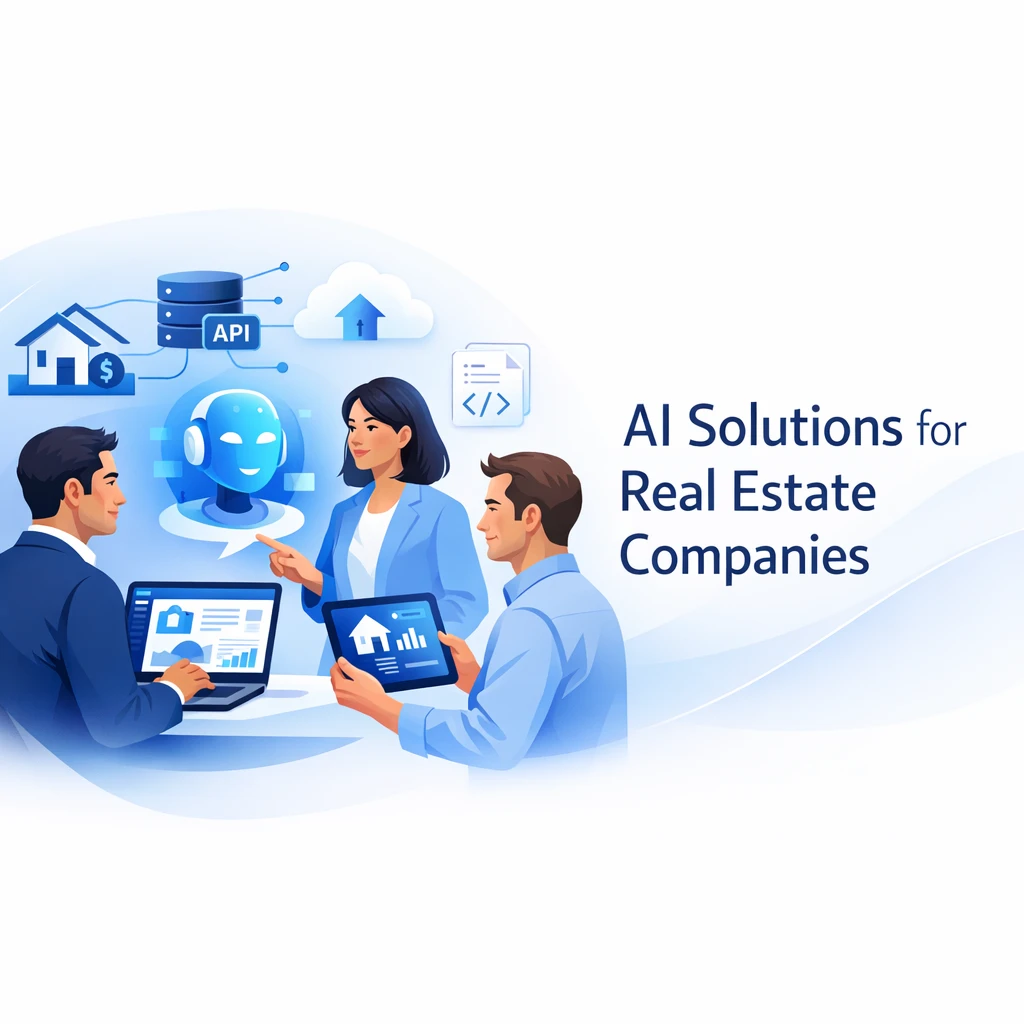
Real estate is a data-rich, customer-focused industry that benefits immensely from intelligent assistants. AI agents can handle repetitive interactions, surface property insights, and automate workflows across leasing, sales, property management, and facilities operations. For SMBs, SMEs, startups, and enterprise teams planning software projects in the USD 5k–200k range, a well-designed AI agent can improve lead conversion, speed up transactions, and deliver better client experiences without prohibitive upfront costs.
Introduction
In 2026, successful real estate organizations are those that blend human expertise with smart software that learns from data. AI agents, when designed for a real estate context, act as digital assistants that can converse with clients, triage inquiries, retrieve property details, schedule tours, draft proposals, and monitor market signals. This article explains what an AI agent is in real estate, why it matters today, how it works, and how to approach a build-vs-buy decision. We’ll share practical implementation steps, industry-focused use cases, cost models, and real-world examples to help leaders in Dubai, the UAE, Saudi Arabia, Qatar, Oman, Kuwait, Bahrain, as well as North America and Europe, plan software projects with clarity and confidence.
What is the Topic?
An AI agent for real estate is a software component or system that uses natural language understanding, reasoning, and action orchestration to complete tasks on behalf of humans. Key capabilities include:
- Understanding inquiries in natural language (text or voice)
- Accessing and synthesizing property data from CMS, MLS, CRM, ERP, and internal databases
- Scheduling appointments, generating proposals, and sending follow-ups
- Automating routine tasks such as data entry, document generation, and client onboarding
- Learning from interactions to improve responses and workflows over time
Why it Matters in 2026
Real estate teams operate in fast-moving markets where responsiveness and data quality drive outcomes. AI agents help by:
- Reducing time-to-contact for new inquiries, increasing conversion rates
- Enriching client interactions with instant access to property details, pricing trends, and scheduling options
- Standardizing processes (KYC, onboarding, disclosures) to reduce risk and improve compliance
- Scaling customer support and advisory services for growing portfolios
For SMBs and SMEs, the value is not just automation; it’s a degree of intelligence and consistency that was previously possible only with large teams. Triostack Technologies can help you design scalable AI agents that align with your business goals and regulatory requirements.
Current Industry Challenges
Real estate markets across the Gulf region and beyond present several hurdles for software initiatives:
- Data fragmentation across CRM, property management systems, marketing platforms, and back-office tools
- Data quality and standardization issues that degrade AI performance
- Regulatory compliance, privacy, and data residency concerns in multiple jurisdictions
- Long project timelines and uncertain ROI for complex enterprise applications
- Adoption barriers and change management among agents and staff
A pragmatic AI agent strategy focuses on solving a few high-value problems first, with measurable milestones and a clear path to scale across regions and product lines.
How the Technology Works
At a high level, an AI agent combines several layers of technology working together:
- Natural Language Understanding (NLU): Interprets user questions, intents, and context.
- Knowledge Layer: Accesses property data, market analytics, compliance rules, and CRM records.
- Reasoning & Orchestration: Plans steps, fetches data, performs actions (e.g., schedule tours), and handles contingencies.
- Execution & Integration: Connects to external systems via APIs (MLS, CRM, ERP, CMS) and internal services.
- Memory & Learning: Remembers prior interactions to personalize responses and improve workflows over time.
Figuring out the right balance between a narrow MVP and a robust, scalable platform is essential. You’ll typically see a core AI engine supplemented by domain-specific adapters, data pipelines, and a user-facing interface (web, mobile, or chat channels).
mermaid diagram: Architecture Overview
Architecture Overview
The architecture below shows a pragmatic, scalable pattern you can adopt for real estate AI agents. This diagram emphasizes modularity so you can replace components as you scale or pivot to new markets.
Step-by-Step Workflow
Step-by-Step Workflow (Extended)
For more complex workflows, the agent can trigger multi-step processes such as lead qualification, offer generation, and compliance checks. The diagram above can be extended to include:
- Document generation (PDFs, disclosures, proposals)
- Signature workflows and e-signing integration
- Automated data enrichment (property valuations, price changes)
- Alerts and proactive outreach based on market signals
Business Use Cases
AI agents in real estate can target a range of value-driving tasks. Below are representative use cases aligned to typical SMB, SME, and startup budgets.
1) Lead Qualification and Nurturing
An AI assistant greets prospects across channels, captures intent, qualifies leads using predefined criteria, and routes to the right agent. It can automatically schedule tours, send follow-ups, and enrich profiles with recent interactions.
2) Property Discovery and Concierge
Clients describe preferences, and the agent returns tailored property lists, compares options, and explains trade-offs. The assistant learns user preferences over time to refine suggestions.
3) Appointment Scheduling and Tour Coordination
Integrated calendars, tour reminders, and rescheduling flows reduce back-and-forth between buyers and agents, while the AI automatically shares meeting details and directions.
4) Leasing and Onboarding Automation
For property managers, AI agents can guide tenants through application forms, collect documents, verify eligibility, and push disclosures with compliant templates.
5) Documentation and Compliance Assistant
Generate and pre-fill documents, disclosures, and lease terms while ensuring regulatory alignment for different regions.
6) Market Intelligence and Pricing Signals
Real-time market snapshots, price trend alerts, and investment scenario analyses help agents and investors make informed decisions.
Industry Applications
While these use cases span the real estate lifecycle, the most immediate ROI typically comes from customer outreach, deal processing, and administrative automation. In the UAE and GCC, regulatory compliance, privacy controls, and data residency constraints must be baked into the solution from day one.
Benefits
- Faster response times and higher contact rates with prospects
- Consistent data collection and standardized processes
- Reduced manual data entry and lower operational costs
- Improved conversion rates through personalized interactions
- Ability to scale customer service without linear staff increases
- Actionable insights from aggregated interaction data
Challenges
- Integrating with legacy systems and data silos
- Maintaining data quality for AI training and inference
- Ensuring privacy, data residency, and regulatory compliance
- Managing change and adoption among agents and staff
- Balancing automation with human judgment in sensitive cases
Common Mistakes
- Starting with an overly broad scope and unclear success metrics
- Underestimating data preparation and governance needs
- Assuming a one-size-fits-all model across regions
- Neglecting security and access controls in the initial design
- Launching without a plan for continuous improvement and monitoring
Best Practices
- Adopt a MVP approach with a focused pain point (e.g., lead qualification or scheduling)
- Prioritize data quality, normalization, and privacy from day one
- Establish clear success metrics: response time, conversion rate, time saved
- Design for regional compliance and data residency requirements
- Plan for ongoing model evaluation, feedback loops, and updates
Build vs Buy Comparison
| Criterion | Build | Buy | Notes |
|---|---|---|---|
| Control | Full control over data, UI, and logic | Limited to vendor capabilities | Trade-off between customization and speed |
| Time to Value | Longer upfront but tailored | Quicker initial deployment | Decide based on MVP goals |
| Cost | Higher initial cost, ongoing maintenance | Lower upfront, ongoing subscription/fees | Consider total cost of ownership |
| Scalability | Designed for your stack, scalable with architecture | Vendor-dependent scaling | Evaluate roadmap and SLAs |
| Security & Compliance | Customizable controls, policy enforcement | Vendor-managed controls | Regulatory alignment is critical |
Estimated Development Cost
Costs for AI agents vary widely based on scope, data complexity, and integration needs. The ranges below reflect typical SMB to SME projects that align with modest budgets and staged delivery, keeping in mind regional considerations in the GCC, Europe, North America, and beyond.
- AI Chatbot (Contact center style, basic scheduling): 5k–25k
- AI Automation and Workflow Orchestration: 15k–80k
- CRM Integration with AI Assistants: 15k–100k
- AI-powered Client Portal or Concierge for property discovery: 10k–40k
- ERP/Property Management System integration with AI: 40k–200k
- AI SaaS MVP for real estate workflows: 20k–80k
Pricing factors include data readiness, number of integrations, security requirements, deployment model (cloud vs. hybrid), regulatory constraints, and regional localization. A phased approach with an MVP can dramatically improve time to value and budget control.
Recommended Technology Stack
The stack below reflects a balanced approach to reliability, scalability, and rapid iteration for real estate AI agents.
| Layer | Components | Rationale |
|---|---|---|
| Frontend | Web, iOS, Android, responsive UI | Accessible channels for agents and customers |
| Backend / API | API Gateway, Microservices, Webhooks | Modular, scalable integration points |
| AI / NLU | LLMs, Vector DB, Retrieval-Augmented Generation (RAG) | Contextual understanding and knowledge retrieval |
| Data & Knowledge | Data Lake, Data Warehouse, CRM/ERP/MLS adapters | Single source of truth for AI reasoning |
| Security & Compliance | Identity & Access Management, encryption, DLP | Regulatory alignment across regions |
| DevOps / CI-CD | CI/CD pipelines, IaC, automated testing | Quality and speed of delivery |
| QA & Testing | Automated tests, performance tests, UX testing | Reliability and user satisfaction |
Future Trends
AI agent technology is evolving quickly. Expect improvements in:
- Multimodal capabilities (text, voice, images, and documents)
- Contextual memory that enables deeper personalization
- Industry-specific knowledge graphs for property data and market signals
- Edge and hybrid deployments for data residency compliance
- Proactive collaboration, where agents initiate outreach based on signals
How Triostack Delivers Projects Globally
Triostack Technologies supports global clients with remote-first delivery teams that combine domain expertise in real estate technology and robust software engineering practices. Our approach emphasizes collaboration, transparency, and measurable outcomes across regions including Dubai, UAE, Saudi Arabia, Qatar, Oman, Kuwait, Bahrain, the United States, the United Kingdom, Europe, Australia, and Singapore.
Key capabilities include:
- Custom Software, Web Development, and Mobile Apps tailored to real estate workflows
- AI Development, Machine Learning, and Data Engineering for agent intelligence
- CRM, ERP integration, and SaaS product development
- Cloud Migration, DevOps, UI/UX, API Development
- Dedicated Teams, QA, Maintenance, and Technical Consulting
Remote Delivery: How Triostack Delivers from India
Triostack leverages a global delivery model that combines time-zone overlap, cost efficiency, and access to a deep engineering talent pool. Our remote delivery approach emphasizes structured collaboration and robust governance:
- Agile and Sprint Planning: Short iterations align with business milestones and stakeholders’ feedback.
- Weekly Demos and transparent progress updates to keep you informed.
- Communication Tools: Slack, Teams, Zoom, Google Meet for real-time collaboration.
- Project Management: Jira, ClickUp, GitHub, GitLab, Azure DevOps for issue tracking and version control.
- CI/CD and Cloud Staging: Automated build and test pipelines with secure staging environments.
- QA and Documentation: Rigorous QA processes and living documentation.
- Security and NDA compliance, with clear IP ownership terms.
- Timezone Overlap and English Communication proficiency for effective collaboration.
- Dedicated Project Managers to maintain alignment and accountability across time zones.
- Long-term Support and Maintenance post-launch to ensure ongoing value.
Why do UAE businesses outsource development to India? The reasons include cost efficiency, a large talent pool, faster hiring, flexible team scaling, high-quality engineering, and strong communication practices when managed with clear governance and security protocols. Triostack has built repeatable processes to minimize risk and maximize value across regions.
CASE STUDIES
Dubai logistics company — AI-assisted parcel and schedule optimization
Challenge: A Dubai-based logistics firm faced delays due to manual scheduling and fragmented data across systems. They needed a scalable AI agent to triage inquiries, optimize routing, and automate documentation.
Approach: Integrated an AI agent with the company’s transportation management system (TMS) and CRM. The agent handled customer inquiries, generated shipping labels, and scheduled pickups, while feeding route optimization data into the dispatch workflow.
Solution: A modular AI agent with adapters for TMS, CRM, and document generation. The system supported multi-language interactions and region-specific compliance templates.
Outcome: Faster response times, reduced manual data entry, and improved on-time delivery rates. The project followed a phased rollout with ongoing monitoring and optimization.
UAE healthcare clinic — Patient intake, appointment scheduling, and triage
Challenge: A healthcare clinic needed to streamline new patient intake, verify insurance, and schedule appointments while maintaining data privacy.
Approach: Built a privacy-conscious AI agent that could collect patient information, check eligibility, and schedule visits, with secure data storage and audit trails.
Solution: Integrated with the clinic’s EHR system and payer portals. The agent provided triage guidance and prepared intake forms for staff review.
Outcome: Faster onboarding, reduced front-desk workload, and more accurate patient data capture. Compliance controls and secure data handling were emphasized from the outset.
Saudi retail business — AI-powered customer engagement and product discovery
Challenge: A retail chain sought to improve customer engagement and cross-sell through a responsive AI assistant across regional websites and apps.
Approach: Implemented an AI agent that could answer product questions, tailor recommendations, and push personalized promotions based on user behavior and inventory signals.
Solution: A multilingual AI agent with product catalog integration, pricing rules, and a marketing automation hook for follow-up emails and messages.
Outcome: Enhanced engagement, higher conversion rates, and more efficient handling of high-volume inquiries without compromising service quality.
Australian startup — Property investment analytics assistant
Challenge: A startup in Australia needed an AI assistant to help investors evaluate property opportunities with data-driven insights.
Approach: Created a risk-adjusted property scoring model, integrated with market data feeds, and exposed a conversational interface for stakeholder discussions.
Solution: An AI-powered investment assistant that could run scenarios, compare properties, and export reports for investors.
Outcome: Faster decision-making and elevated investor confidence through more transparent analysis and reproducible reports.
UK SaaS company — AI-enabled customer success portal
Challenge: A UK-based SaaS provider wanted to reduce support load while keeping high-quality customer success interactions.
Approach: Deployed an AI agent that triaged tickets, answered common questions, and guided customers through onboarding and feature discovery.
Solution: Integrated with the company’s CRM and knowledge base, with analytics to monitor user satisfaction and drive product feedback loops.
Outcome: Improved first-contact resolution rates and faster onboarding for new customers with scalable support automation.
Cost Section: Realistic Pricing for SMBs
Pricing is a function of scope, data complexity, and regional considerations. Here are practical ranges you can use when budgeting a project with Triostack or a similar partner. Note that these figures assume a phased approach with clear milestones and a focus on measurable outcomes.
- Business Website: 5k–15k
- Customer Portal: 10k–40k
- CRM: 15k–100k
- ERP: 40k–200k
- AI Chatbot: 5k–25k
- AI Automation: 15k–80k
- SaaS MVP: 20k–80k
- Enterprise Web App: 30k–200k
These ranges reflect typical complexity and integration requirements. Factors that influence price include data readiness, regulatory localization (KYC, AML, privacy laws), number of integrations (CRM, MLS, ERP), deployment model, and post-launch support. Working with a global partner like Triostack enables you to align price, scope, and quality through iterative delivery and robust governance.
Future Trends
- Continued growth in retrieval-augmented generation (RAG) for specialized domain knowledge
- Greater emphasis on data governance, privacy-preserving AI, and compliance automation
- Deeper integration with property data sources and market analytics
- Multi-channel and voice-enabled real estate AI agents becoming standard
How Triostack Delivers Projects Globally
Triostack combines global delivery experience with domain expertise in real estate, enterprise software, and AI. We emphasize clarity, collaboration, and measurable outcomes as we partner with you from discovery through deployment and ongoing support.
Our engagement model supports remote delivery from India with:
- Structured Agile processes, sprint planning, weekly demos, and transparent status reporting
- Dedicated project managers and cross-functional teams with clear responsibilities
- Robust security practices, NDA/IP protection, and strict data handling policies
- Timezone overlap for daily coordination, along with asynchronous updates via Jira, ClickUp, Slack, and email
Why Businesses Choose Triostack
Real estate organizations need reliable partners who can translate business goals into scalable software. Triostack offers a blend of:
- Custom Software development and web/mobile solutions
- AI development, machine learning, and data engineering
- CRM, ERP, SaaS, cloud migration, and DevOps
- UI/UX excellence, API development, and dedicated teams
- QA, maintenance, technical consulting, and risk management
We emphasize practical outcomes, documented decisions, and open communication to ensure your project stays on track and aligned with business value.
Conclusion
AI agents offer a powerful path for real estate firms to accelerate operations, enhance client experiences, and scale revenue without compromising governance or compliance. Whether you start with a targeted MVP or pursue a broader platform, the right architecture, data strategy, and partnerships matter as much as the technology itself. Triostack’s experience helping clients across Dubai, the UAE, Saudi Arabia, and beyond demonstrates how to design, build, deploy, and maintain AI-enabled real estate solutions that deliver tangible business outcomes.
Frequently Asked Questions
- What is an AI agent in real estate? An AI agent is a software component that uses natural language understanding, data integration, and automated actions to assist clients and staff with tasks such as inquiries, scheduling, documentation, and analytics.
- How long does it take to build an AI agent? Time to value depends on scope. A focused MVP may take 6–12 weeks for a basic chatbot with scheduling, while a full automation platform with data integrations can take 4–9 months.
- What regions require data residency considerations? Regulatory environments in the UAE, GCC countries, Europe, and certain US states require careful data residency and privacy controls.
- Build vs Buy: how should I decide? Start with a MVP to validate value and ROI. If you need deep customization, tight data control, or unique compliance rules, building in-house or with a partner may be preferable. If speed and cost are primary, a well-supported vendor solution can be a good stepping stone.
- How does Triostack handle remote delivery? We use Agile, weekly demos, and robust collaboration tools (Slack, Teams, Jira, ClickUp, GitHub) to maintain alignment, security, and IP ownership while delivering high-quality software.
Internal Resources
For readers who want to explore related topics, see: Case Studies, Remote Delivery, and Build vs Buy.
Mermaid Diagram: Deployment Diagram
Case Studies
Links to case studies and project briefs can be added here as you publish more detail. The examples above illustrate how real-world clients approach AI agent programs with Triostack as a partner.
REMOTE DELIVERY: How Triostack Delivers Projects Globally
Triostack’s remote delivery model is designed for high-value tech programs with cross-border teams. We emphasize discipline, transparency, and predictable delivery to ensure successful outcomes for real estate digital products.
- Agile governance: Product discovery, sprint planning, and backlog management with clear milestones.
- Communication cadence: Regular demos and status updates via Slack, Teams, Zoom, and email.
- Tooling: Jira, ClickUp, GitHub/GitLab, Azure DevOps, and Git-based workflows for collaboration and traceability.
- Security: NDA, IP ownership, secure data handling, and access controls across regions.
- Quality: Automated testing, performance testing, and user acceptance testing as part of every sprint.
- Support: Long-term maintenance and support with defined SLAs and knowledge transfer.
Why UAE businesses outsource development to India includes cost efficiency, a large talent pool, faster hiring, flexible scaling, high-quality engineering, and strong communication. When managed with governance, this model can deliver high-velocity software projects while maintaining regional compliance and data privacy.
SEO and Keywords
For search visibility, this article targets terms such as AI agent development, real estate AI use cases, AI in real estate, AI chatbot for real estate, and real estate automation. The content is structured to be informative, practical, and action-oriented for decision-makers in Dubai, UAE, Saudi Arabia, Qatar, Oman, Kuwait, Bahrain, the United States, Canada, the United Kingdom, Europe, Australia, and Singapore.
Notes on Realistic Price Ranges
Because real estate AI projects vary significantly in scope and data complexity, the ranges above reflect reasonable expectations for SMBs and SMEs. If you’re evaluating a project, start with a well-defined MVP, confirm data readiness, and set milestones that align with business impact metrics (e.g., reduced response times by X%, increased qualified leads by Y%).
Glossary
FAQ Highlights
- What are the typical components of an AI agent for real estate?
- How do you measure ROI for an AI agent project?
- What are the data governance considerations for GCC markets?
CTAs
Businesses planning similar solutions often benefit from experienced software development partners like Triostack Technologies. If you’re planning a similar software project, Triostack can help you design, build, deploy and maintain a scalable solution.
Triostack Team
Technology Evangelist & Writer
Triostack Team is an experienced writer and technologist, exploring the intersections of AI, cloud architecture, and modern application development. Passionate about turning complex technical concepts into accessible insights.