AI Agent Development for Enterprise Operations: Cost, Use Cases, and Implementation Strategy
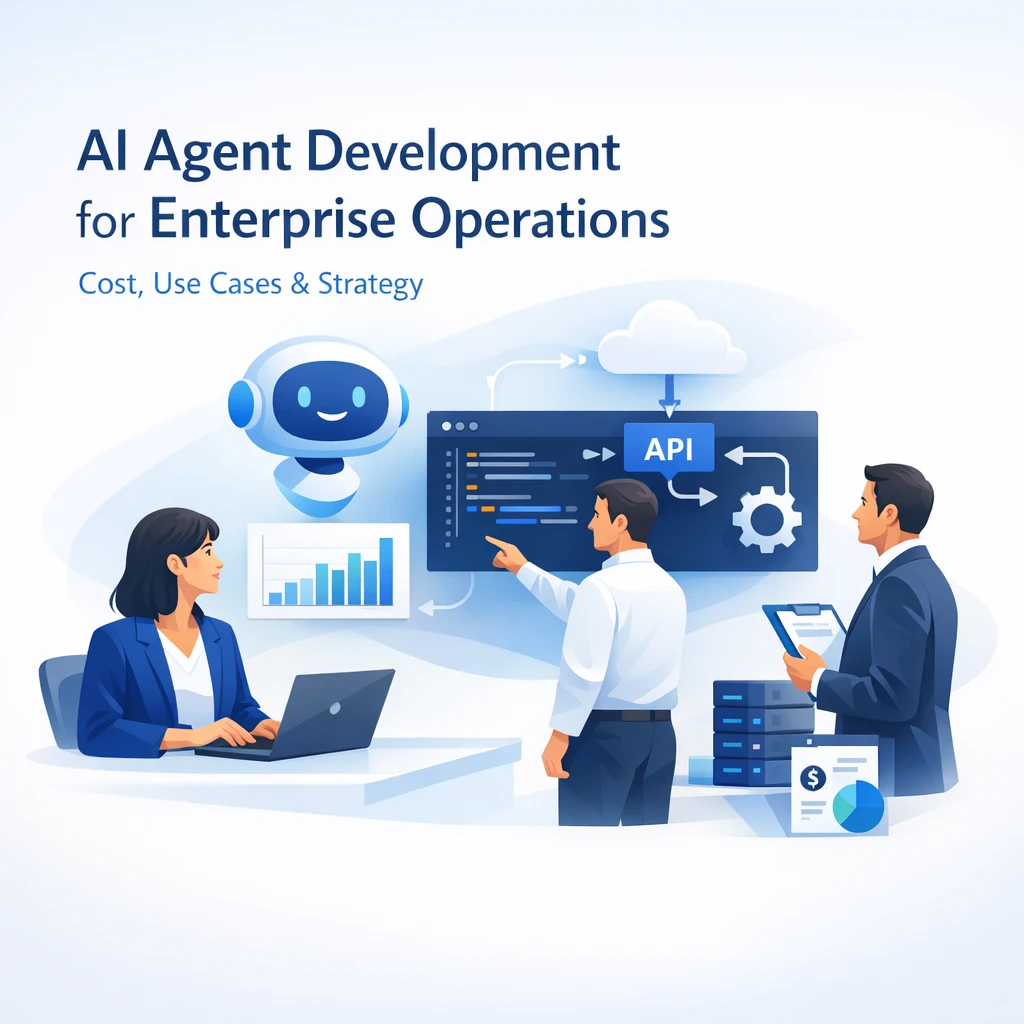
As enterprises pursue smarter operations, AI-powered agents are becoming essential for automating decisions, orchestrating workflows, and providing proactive insights. This article examines how organizations—especially SMBs, SMEs, startups, and established enterprises across the UAE, GCC, the United States, Europe, and the Asia-Pacific region—can approach AI agent development with a practical, structured strategy. Across custom software, web and mobile development, AI development, and cloud-enabled DevOps, Triostack Technologies helps global teams build scalable, maintainable solutions without sacrificing time-to-value.
Introduction
AI agents combine language-based reasoning, data access, and action mechanisms to perform tasks on behalf of humans. In enterprise operations, they can screen and route requests, analyze real-time data, orchestrate multi-system workflows, and learn from feedback to improve over time. The goal is not to replace human capability, but to augment decision-making, speed up routine tasks, reduce operational risk, and unlock new capabilities for growth. This article offers a practical, practitioner-friendly view of how to plan, build, and scale AI agents for enterprise environments, with examples, best practices, and a roadmap to execution.
Triostack Technologies operates globally, delivering custom software, web and mobile apps, AI development, and cloud-native delivery through remote partnerships. Our approach emphasizes governance, security, and measurable outcomes to ensure that AI agents align with enterprise standards and regulatory requirements.
What is the Topic?
AI agent development refers to the end-to-end process of creating autonomous software entities that can perceive, reason, and act within a business ecosystem. Core components include:
- Perception layer for data ingestion from ERP, CRM, databases, chat interfaces, and IoT sensors.
- Reasoning layer built on large language models (LLMs) and retrieval-augmented generation (RAG) to interpret queries and plan actions.
- Action layer that triggers API calls, invokes workflows, or updates systems like CRM, ERP, or ticketing platforms.
- Orchestration and governance to manage workflows, security, access control, auditing, and compliance.
- Observability for monitoring, dashboards, and continuous improvement using feedback loops.
In practice, an AI agent might converse with a human operator to gather requirements, retrieve data from multiple sources, and then execute a multi-step operation—such as approving a purchase request after cross-checking budget, stock levels, and supplier contracts.
Why It Matters in 2026
The business landscape in 2026 emphasizes speed, resilience, and data-driven decision making. AI agents offer:
- Operational efficiency through automation, reducing manual handoffs and process latency.
- Improved accuracy by consolidating data from disparate systems and validating decisions against rules and policies.
- Scalability as demand grows or seasonal spikes occur, with the ability to scale up or down quickly.
- 24/7 capability to monitor operations, triage issues, or respond to customers outside business hours.
- Regulatory alignment through auditable workflows, access controls, and data governance practices.
For regional markets such as Dubai, UAE, Saudi Arabia, Qatar, Oman, Kuwait, Bahrain, and expanding footprints in the United States, Canada, UK, Europe, Australia, and Singapore, AI agents must also respect local data privacy laws, cross-border data transfer rules, and industry-specific compliance standards. The organizations that succeed will blend human-centric design with robust automation, guided by a clear ROI model and a governance framework.
Current Industry Challenges
Enterprises exploring AI agents often face a set of recurring challenges:
- Data silos and quality hinder reliable reasoning and actionable outputs.
- Complex integrations across ERP, CRM, HRIS, data lakes, and bespoke systems.
- Security and compliance constraints around access, data residency, and auditability.
- Skill gaps and the need for cross-functional teams spanning data, product, IT, and security.
- Uncertain ROI due to evolving use cases and variability in solution scope.
- Change management and adoption resistance within organizations accustomed to manual processes.
Triostack’s experience across multiple regions shows that successful AI agent programs start with a clear problem statement, a well-scoped pilot, and an architectural blueprint that anticipates integrations, security, and governance from Day One.
How the Technology Works
At a high level, AI agents blend:
- LLMs and retrieval to understand intent, reason, and plan actions based on knowledge stored in document stores or databases.
- Memory and context management to recall prior interactions, preferences, and organizational rules.
- Decision and action modules that translate plans into API calls, workflow triggers, and database updates.
- Security and governance to enforce roles, permissions, data handling policies, and audit trails.
In practice, an agent uses a prompt-augmented reasoning loop: it retrieves relevant data, reasons about a problem, proposes a plan, executes actions, and then monitors outcomes for feedback. Modern architectures employ retrieval-augmented generation to ground responses in enterprise data, while policy-based controls ensure actions stay within defined boundaries.
Architecture Overview
The following diagram shows a practical, scalable reference architecture for an enterprise AI agent program. It emphasizes data governance, secure integration, and observability across environments.
Step-by-Step Workflow
- Problem framing: identify a tangible operational challenge with measurable impact (e.g., reduce order processing time by X%).
- Data assessment: inventory data sources, data quality, and access controls; design a data fabric strategy.
- Platform selection: choose LLM providers, tooling for orchestration, and integration approach (APIs, events, webhooks).
- Prototype: build an MVP focusing on a narrow scope to validate feasibility and ROI.
- Data integration: connect ERP/CRM, ticketing, and relevant data stores; implement data normalization.
- Policy and governance: define roles, permissions, data residency rules, and audit requirements.
- Training and testing: tune prompts, create evaluation rubrics, and implement synthetic data for testing when needed.
- Deployment: roll out to production with CI/CD, feature flags, and phased release.
- Monitoring: track KPIs, observe failures, and iterate with feedback loops.
Business Use Cases
Below are representative use cases spanning operations, customer engagement, and internal workflows. Each illustrates a practical setup, typical inputs, and expected outcomes.
1) Internal Helpdesk and IT Operations
An AI agent acts as the first line of support for employees, triaging requests, pulling knowledge base articles, and creating tickets in the ITSM system. It can also perform routine actions such as provisioning accounts, resetting passwords, or scheduling maintenance windows, all while logging activity for auditing.
2) Intelligent Process Automation (RPA + AI)
In accounting or procurement, the agent analyzes incoming invoices, validates them against purchase orders and contracts, and triggers payment workflows. It learns from exceptions to reduce manual review time and escalates discrepancies to humans with context-rich summaries.
3) AI-Driven Customer Relationship Management
Within a CRM, an AI agent can summarize customer interactions, suggest next-best actions for sales reps, and automatically update records after calls or meetings. It can route leads to the right owners based on historical win rates and geography, while maintaining data integrity across systems.
4) Operations Analytics and Decision Support
The agent continually analyzes supply chain telemetry, production line data, and quality metrics, delivering alerts and recommended actions to operations managers. It can simulate scenarios (What-if analyses) to support capacity planning and risk mitigation.
5) Supply Chain and Logistics Orchestration
For a logistics or e‑commerce context, the AI agent can optimize routes, monitor carrier performance, and trigger resourcing adjustments in response to real-time events such as traffic or weather disruptions.
Industry Applications
While the underlying technology is universal, industry-specific considerations matter. Here are examples across regions and sectors:
- Dubai / UAE: AI agents integrated with ERP and logistics platforms to streamline customs documentation, appointment scheduling, and fleet optimization for urban delivery networks.
- Saudi Arabia / GCC: Compliance-aware agents that manage procurement workflows in adherence to local procurement rules and supplier registration requirements.
- UK / Europe / US: B2B SaaS firms deploying AI agents to manage onboarding, subscription changes, and churn risk assessments within CRM ecosystems.
- Australia / APAC: AI agents facilitating field service coordination and predictive maintenance for manufacturing and utilities customers.
Benefits
- Productivity lift through automation of repetitive tasks and faster decision loops.
- Consistency and compliance with auditable actions and policy enforcement.
- Faster onboarding for new processes via guided, AI-assisted workflows.
- Improved customer experience with faster responses and proactive engagement.
- Cost optimization by reducing manual labor and improving resource utilization.
Challenges
- Balancing autonomy with human oversight to prevent undesired actions.
- Ensuring data governance and privacy across cross-border data flows.
- Managing vendor and model drift as data evolves and business rules change.
- Addressing change management and user adoption in large organizations.
Common Mistakes
- Launching a broad AI agent program without a clear scope or KPI framework.
- Underinvesting in data quality, cataloging, and governance before enabling automation.
- Over-relying on a single data source or a single vendor for critical workflows.
- Neglecting security, access controls, and IP protection in the rush to delivery.
Best Practices
- Define a data strategy with source systems, data quality targets, and a data access policy.
- Start small, evolve fast with a pilot that delivers measurable value and a clear expansion path.
- Adopt a modular architecture with clearly bounded agents, shared services, and API contracts.
- Implement governance from Day 1 including security, privacy, and auditability.
- Measure outcomes using KPIs such as cycle time, error rate, and user satisfaction.
- Plan for change management with training, documentation, and stakeholder engagement.
Build vs Buy
enterprises often face a choice between building custom AI agents in-house or partnering with an external team. The decision depends on strategic goals, time-to-value, and risk tolerance.
| Aspect | Build | Buy/Partner |
|---|---|---|
| Control | Highest control over architecture, data, and governance | Controlled by vendor capabilities, but can negotiate SLAs |
| Time-to-value | Longer upfront; incremental delivery possible | Faster initial deployment, with roadmap alignment |
| Cost certainty | Capex intensive; ongoing maintenance | Opex model; predictable monthly costs |
| Risk | Higher if data and governance plans are incomplete | Lower risk with mature templates and governance practices |
For many SMBs and scale-up SMEs, a phased approach—build core capabilities in-house while partnering for specialized modules (e.g., AI copilots for CRM, or AI-based forecasting) can balance control and speed.
Estimated Development Cost
Costs vary by scope, data complexity, and integrations. The ranges below reflect typical SMB/SME projects that aim for a structured MVP and a scalable production-ready product.
| Project Type | Description | Typical Range (USD) |
|---|---|---|
| Business Website | Basic site with content management and analytics | 5k – 15k |
| Customer Portal | User authentication, data view, workflow integration | 10k – 40k |
| CRM | Sales/Client management, automation, analytics | 15k – 100k |
| ERP | Finance, supply chain, HR integration | 40k – 200k |
| AI Chatbot | Conversational agent for customers or employees | 5k – 25k |
| AI Automation | RPA/AI-enabled process automation | 15k – 80k |
| SaaS MVP | New software-as-a-service offering with core AI features | 20k – 80k |
| Enterprise Web App | Feature-rich enterprise-grade app with integrations | 30k – 200k |
Pricing factors include data complexity, volume, security requirements, compliance needs, integration depth, and ongoing maintenance. A disciplined scoping workshop helps align expectations and budget with outcomes.
Recommended Technology Stack
This stack reflects practical, scalable choices for enterprise-grade AI agent programs. It emphasizes modularity, security, and cloud-native delivery.
- Frontend: React or Vue for dashboards and agent interfaces, with responsive design and accessibility in mind.
- Backend: Node.js (Express/Koa) or Python (FastAPI) for API services; microservices architecture where applicable.
- AI & ML: LLM providers (OpenAI, Claude, or open models like Llama/Open-Source stacks) with retrieval-augmented generation; model fine-tuning where appropriate.
- Data & Storage: PostgreSQL, MongoDB for operational data; data lake on S3/GCS/ADLS for analytics; Redis for caching.
- Search & Knowledge: Vector databases (Pinecone, Weaviate, or open-source options) for semantic search and retrieval.
- DevOps: GitHub Actions or GitLab CI/CD; Docker & Kubernetes; Terraform for infrastructure as code; ArgoCD/Flux for GitOps.
- Security: OAuth/SAML SSO, IAM, network micro-segmentation, secrets management (Vault or similar).
- Observability: Prometheus, Grafana, Elastic stack for logs, and an incident response workflow integrated with the agent platform.
- Integrations: REST/GraphQL APIs, messaging (Kafka or RabbitMQ), and native connectors for CRM/ERP (Salesforce, SAP, Oracle, Oracle NetSuite, etc.).
Future Trends
- Governed AI with policy-driven agents that enforce company rules and regulatory compliance by design.
- Edge and on-device inference for privacy-sensitive workloads in regulated industries.
- Privacy-preserving ML and differential privacy to protect sensitive data while enabling insights.
- No-code/low-code platform capabilities that empower domain experts to prototype agents quickly.
- AI operations (AIOps) to monitor model performance, drift, and security across large deployments.
How Triostack Delivers Projects Globally (Remote Delivery)
Triostack enables remote delivery from multiple time zones, including India, to serve clients across the UAE, US, UK, Europe, Australia, and beyond. The following approach emphasizes collaboration, transparency, and quality.
Delivery Model
- Agile framework with iterative sprints and backlog prioritization aligned to business value.
- Dedicated project managers ensuring continuity and single-point accountability across time zones.
- Weekly demos to review progress, gather feedback, and adjust scope as needed.
Communication & Collaboration
- Slack for daily communication; Teams and Zoom or Google Meet for meetings.
- Jira or ClickUp for project management; GitHub or GitLab for version control and code reviews.
- CI/CD pipelines, cloud staging environments, and automated QA checks to ensure quality at every step.
Security, IP, and Compliance
- NDA and formal IP ownership agreements; robust data handling policies and security reviews.
- Privacy-by-design and industry-standard controls to protect data across environments and jurisdictions.
Timezone Overlap and Language
We optimize timezone overlap (e.g., UAE business hours aligning with India-based teams) to maximize collaboration windows and minimize latency in decision-making. English is the primary language for documentation and communications to reduce misinterpretation.
Why UAE Businesses Outsource to India
- Cost efficiency without compromising quality, enabling competitive pricing for SMBs and SMEs.
- Large talent pool with deep expertise in AI, ML, cloud, and enterprise software engineering.
- Faster hiring and scale-up capability to meet project timelines.
- Flexible team scaling to accommodate evolving project scope and budget constraints.
- Strong communication and mature project-management practices that align with global clients.
Case Studies (Realistic Scenarios)
The following cases illustrate practical AI agent implementations in real-world settings. Names and metrics are anonymized to protect client confidentiality, but the contexts reflect genuine industry scenarios.
Case Study 1: Dubai-based logistics company
Challenge: Fragmented visibility across transport partners, manual exception handling, and delayed dock-to-door times. Solution: An AI agent integrated with the WMS and TMS platforms, orchestrating routing decisions, carrier assignment, and dynamic scheduling. It retrieved real-time traffic, weather, and carrier performance data to optimize routes. Result: Improved delivery reliability and reduced manual triage time for dispatchers. The system logged decisions for auditing and continuous improvement.
Case Study 2: UAE healthcare clinic
Challenge: High patient wait times and inconsistent appointment scheduling. Solution: An AI agent that managed appointment intake, triggered follow-up communications, and surfaced triage recommendations to clinicians. The agent also pulled up patient history from the EMR to guide triage and reduce redundant data entry. Result: Shorter wait times, more consistent patient flow, and improved patient satisfaction metrics across clinics.
Case Study 3: Saudi retail business
Challenge: Manual order processing and supplier negotiations slowing replenish cycles. Solution: An AI agent integrated with the procurement ERP and supplier portal, automatically validating purchase orders, flagging exceptions, and initiating approval workflows. Result: Faster replenishment cycles, better contract compliance, and a single source of truth for procurement decisions.
Case Study 4: UK SaaS company
Challenge: Onboarding and customer success workflows were disjointed across systems, leading to churn risk. Solution: An AI agent that tracked user journeys, suggested next-best actions for onboarding, and updated CRM records after key events. Result: Improved onboarding efficiency and stronger alignment between product and customer success teams.
Future Trends (Additional Context)
- AI agents with regulatory-aware prompts that adapt to regional requirements (GCC, EU, US) through policy-driven controls.
- Hybrid AI architectures that combine open-source models with private data to improve governance and customization.
- Composable AI where agents are built from reusable components and services, enabling faster delivery with lower risk.
Frequently Asked Questions
What is an AI agent in an enterprise context?
An AI agent is a software entity that perceives, reasons, and acts to fulfill business objectives. It can interact with humans and systems, automate decision loops, and improve processes over time through feedback and learning.
How long does it take to develop an AI agent project?
Typical engagements begin with a discovery and scoping phase (2–4 weeks), followed by a one-to-three-month MVP, and then iterative releases. Larger, regulated deployments may require more time for governance, security reviews, and compliance testing.
What’s the role of data quality in AI agents?
Data quality directly impacts the reliability of decisions and actions. A strong data governance foundation, data cleansing, schema standardization, and secure data access controls are essential before enabling automation.
How does Triostack support remote delivery?
Triostack combines agile methodologies, robust project management, and secure collaboration tooling to deliver high-quality software from remote locations. We emphasize clear communication, governance, and long-term support with dedicated teams.
What You Can Do Next
Businesses planning similar AI-driven enterprise solutions can benefit from partnering with experienced software development teams that specialize in custom software, AI development, CRM and ERP integrations, and cloud-native DevOps.
If you're planning a software project in the USD 5k–200k range, consider outlining a focused pilot with clear success criteria. A quality partner will help you map data requirements, governance, and architecture before proceeding to delivery.
Businesses planning similar solutions often benefit from experienced software development partners like Triostack Technologies.
Triostack Team
Technology Evangelist & Writer
Triostack Team is an experienced writer and technologist, exploring the intersections of AI, cloud architecture, and modern application development. Passionate about turning complex technical concepts into accessible insights.