AI Agent Development Cost for Customer Support in UAE: Pricing, Use Cases, and Implementation Strategy
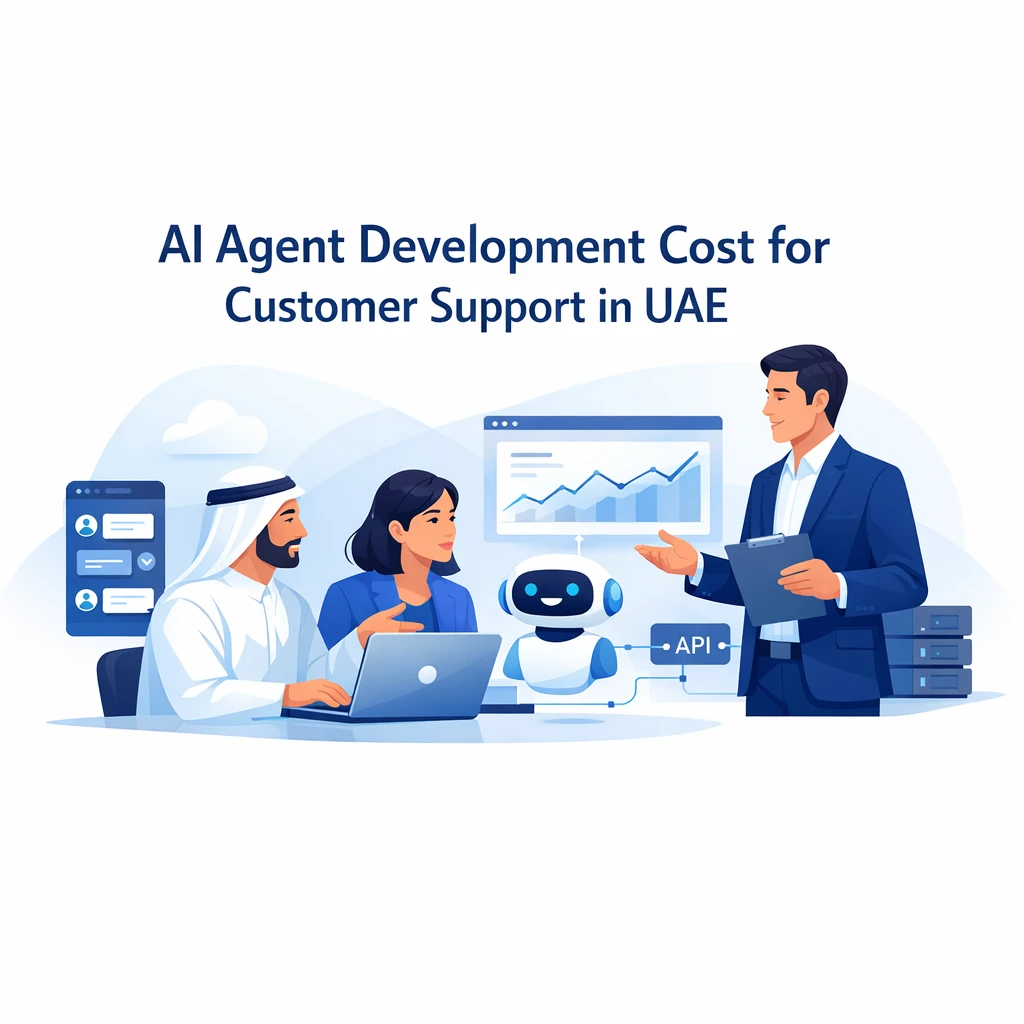
Customer expectations for fast, accurate, and seamless support are higher than ever across the UAE and its neighboring markets. Smart AI agents powered by modern natural language understanding, robust integrations, and secure data handling can transform how a business handles inquiries, triages tasks, and drives customer satisfaction. This article provides a practical, finance-aware roadmap for SMBs, SMEs, startups, CEOs, CTOs, and product leaders considering an AI agent for customer support. We balance pricing realism with implementation guidance and real world examples to help you plan a scalable path forward.
Introduction
As digital transformation accelerates, the UAE market stands out for multi channel customer engagement, multilingual support needs, and rapid adoption of AI driven automation. An AI agent for customer support is not a vanity project; it is a strategic lever that can reduce operational costs, improve response times, and unlock deeper customer insights when designed with the right architecture and governance. This article walks you through what an AI agent is, why it matters in 2026, how the technology works, and how to plan, price, and implement a project that fits a typical SMB to mid market budget range ranging from a few thousand to a couple hundred thousand dollars.
What is the Topic?
An AI agent for customer support is a software system that understands customer inquiries, retrieves or generates accurate responses, executes routine actions, and hands off to human agents when necessary. It may operate as a chat bot on a website or app, a voice assistant in a call center, or as a hybrid assistant that spans messaging apps, email, and voice channels. In practice, a well crafted AI agent blends:
- Natural language understanding to interpret intents in multiple languages common in the region
- Dialogue management to steer conversations smoothly
- Integrations with CRM, ERP, order management, ticketing, and knowledge bases
- Automation of routine tasks such as data retrieval, updates, and ticket creation
- Analytics for continuous improvement and governance to protect data
Crucially, a production ready AI agent requires careful scope definition, data readiness, and strong security practices to meet regional regulations and customer expectations.
Why it Matters in 2026
Across the GCC and wider global markets, AI driven support solutions are shifting from niceties to necessities. Key drivers include:
- 24/7 support without a proportional increase in headcount, which is especially valuable for international customers and time zone coverage
- Multilingual capabilities to support Arabic, English, and other regionally common languages
- Consistency in handling common inquiries, enabling human agents to focus on high value interactions
- Data driven insights from customer interactions that inform product, marketing, and operations
From a cost perspective, SMBs in the UAE and beyond can access scalable automation with clear return on investment, provided the solution is designed with a pragmatic scope and phased rollout plan.
Current Industry Challenges
Despite strong market opportunities, several challenges must be addressed in any AI agent project:
- Data fragmentation across systems such as CRM, ERP, help desk, and knowledge bases
- Data privacy and regulatory compliance, including cross border data flows and local data residency expectations
- Maintaining up to date knowledge bases and workflows as products and services evolve
- Multi channel integration including web, mobile, WhatsApp, Messenger, and voice
- Quality of conversations, including handling escalation, sentiment, and context switching
- Change management and alignment with human agents and service levels
How the Technology Works
An AI agent for customer support combines several layers of technology and governance. A practical implementation balances capability, reliability, and maintainability:
- Natural language processing and understanding to identify intents and entities
- Dialogue management to track conversation state and route to appropriate actions
- Knowledge access from structured data (CRM, ERP) and unstructured data (FAQs, manuals)
- Automations and action execution such as creating tickets, updating orders, or generating reports
- Secure data handling with role based access control, encryption, and audit trails
- Monitoring, analytics, and model governance to ensure quality and compliance
Architecture Overview
The architecture below demonstrates a practical, scalable design. A robust architecture ensures reliable performance across languages, channels, and regions. It supports phased expansion from a lean chatbot to a full service agent with human handoffs.
Notes
- Data flows are designed for modular upgrades; you can swap AI providers or add on additional channels without structural changes
- Security is implemented at every boundary with tokenization and least privilege access
Step by Step Workflow
- Discovery and scope alignment with measurable outcomes such as reduced handle times and increased CSAT
- Data assessment and privacy readiness including data residency considerations for UAE and neighboring regions
- Design of the conversation flows, escalation rules, and knowledge base requirements
- Architecture selection and technology stack decisions aligned with security and compliance
- Prototype and iterative validation with real user feedback
- Full scale deployment with phased channel rollout and robust monitoring
- Runtime governance including model refresh, content moderation, and security reviews
- Continuous improvement through analytics and user feedback
Business Use Cases
Below are practical use cases that demonstrate value in a typical UAE setting. Each use case includes a brief description, success indicators, and implementation notes.
- Order status and tracking for ecommerce and logistics firms
- Appointment scheduling for clinics and diagnostic centers
- Returns processing and warranty inquiries for retail
- Technical support triage for B2B SaaS platforms
- Billing inquiries and subscription management for service providers
Industry Applications
The AI agent approach scales across industries common in the region, including logistics, healthcare, retail, manufacturing, and financial services. Key industry themes include multilingual support, compliance with local data privacy norms, and integration with sector specific back ends such as ERP, EHR, and CRM systems.
Benefits
- Reduced average handle time and increased first contact resolution
- Greater agent productivity through hands off repetitive requests
- Improved SLA adherence and 24 7 availability across multiple time zones
- Consistent customer experience and auditable interactions
- Rich analytics for product and service improvements
Challenges
- Data quality and completeness in legacy systems
- Balancing automation with human empathy in sensitive interactions
- Ensuring reliable multilingual performance across languages and locales
- Managing governance, security, and regulatory compliance
Common Mistakes
- Underestimating data preparation and integration complexity
- Rolling out without a clear escalation process to humans
- Overlooking privacy, consent, and data retention policies
- Soaking the project in vendor hype without pragmatic milestones
Best Practices
- Start with a constrained, high value use case and expand iteratively
- Design for multilingual support with fallbacks to human agents
- Invest in a high quality knowledge base and internal SLAs
- Implement strong security posture from day one including NDAs and IP ownership agreements
- Establish a governance model for model training, updates, and auditing
Build vs Buy Comparison
Choosing between building the AI agent in house, buying a pre built solution, or partnering with a software company depends on control needs, speed, and budget. The table below contrasts key considerations.
| Decision Area | Build In House | Vendor / Ready Made |
|---|---|---|
| Time to value | Longer due to development and data preparation | Faster to deploy with baseline capabilities |
| Customization | High flexibility but requires ongoing investment | Limited to vendor capabilities, customizable to an extent |
| Cost | CapEx heavy upfront, variable OpEx | predictable pricing, often lower initial cost |
| Control & IP | Full control over data and IP | IP ownership typically with vendor; data policies vary |
| Security & Compliance | Customizable controls, can align with local norms | Depends on vendor security posture |
Estimated Development Cost
Costs vary by scope, data readiness, channel breadth, and integrations. The ranges below reflect typical SMB to small mid market projects in the UAE and nearby regions. Real world projects often start lean and scale with value delivered.
| Service Type | Typical Range USD | Notes |
|---|---|---|
| Business Website | 5k 15k | Content, forms, basic AI chat integration |
| Customer Portal | 10k 40k | Account access, ticketing, order history |
| CRM | 15k 100k | Lead to opportunity lifecycle, automation |
| ERP | 40k 200k | End to end business process integration |
| AI Chatbot | 5k 25k | Multilingual, domain specific knowledge |
| AI Automation | 15k 80k | RPA style tasks, workflow orchestration |
| SaaS MVP | 20k 80k | Multi tenant architecture, core features |
| Enterprise Web App | 30k 200k | Complex integrations and performance requirements |
Pricing factors include multi language support, integration complexity with CRM and ERP, data governance and security requirements, hosting location, and the need for ongoing maintenance and model updates. A phased approach with a minimum viable product can significantly reduce risk and speed time to value.
Recommended Technology Stack
The right stack balances speed, reliability, and compliance. A pragmatic stack for a UAE based AI customer support agent might include:
- Frontend: React or Next.js for responsive web interfaces
- Backend: Node.js or Python with robust API design
- AI Layer: OpenAI API or Azure OpenAI for language understanding, with local fallback options
- Dialogue & Orchestration: Custom rule engine or Rasa like components for on demand control
- Knowledge Base: ElasticSearch or vector databases for semantic search
- CRM / ERP Integrations: RESTful APIs, with event driven patterns
- Cloud & DevOps: AWS, Azure, or Google Cloud with IAM, VPC, and encryption
- Security & Compliance: Data masking, encryption at rest in transit, access controls
Future Trends
Expect additional capabilities that will influence how you plan and scale AI agents in the coming years:
- Multimodal agents that understand text, voice, and images
- On device edge processing for privacy sensitive interactions
- Explainable AI to provide rationale for agent decisions
- Deeper integration with workflow automation and RPA
- Stronger governance models for safer model updates and data handling
How Triostack Delivers Projects Globally
Triostack operates as a global software partner, delivering high quality engineering from distributed teams. Our approach emphasizes disciplined project management, transparent communication, and rigorous quality assurance. The core capabilities that help us execute complex AI driven customer support projects include:
- Custom Software development across web and mobile platforms
- AI Development and Machine Learning services
- CRM and ERP integration expertise
- SaaS product design and cloud native architecture
- DevOps and CI/CD automation for rapid, reliable releases
- UI UX design focused on delightful, accessible experiences
- API development and ecosystem integration
- Dedicated teams and QA for scalable, long term partnerships
- Technical consulting to align business goals with technology strategy
Remote Delivery
Triostack offers a robust remote delivery model from our India based development centers. This model aligns with agile principles and is designed to maximize collaboration with UAE, GCC, and global teams. Key elements include:
- Agile driven by Scrum or Kanban with clear sprint planning and reviews
- Weekly demos and stakeholder updates via Slack, Teams, Zoom, or Google Meet
- Project management and issue tracking in Jira or ClickUp
- Code management in GitHub or GitLab with branch based workflows
- CI CD pipelines and automated testing with Azure DevOps or equivalent
- Cloud staged environments for safe testing and QA
- Comprehensive QA, security reviews, and documentation
- Clear NDA, IP ownership agreements, and governance around data usage
- Timezone overlap to enable real time collaboration with UAE teams
- English communication as the primary collaboration language
- Dedicated project managers for long term support and ongoing enhancements
Why UAE businesses opt for this model includes cost efficiency, access to a large talent pool, faster hiring cycles, flexible team scaling, high quality engineering, and strong communication practices. Triostack combines this global delivery with local account management to ensure that cultural and business needs are met throughout the project lifecycle.
Case Studies
Dubai Logistics Company
Problem: A Dubai based logistics firm needed 24 7 customer support across multiple languages to handle order status inquiries and delivery windows. Approach: Triostack delivered a phased AI agent with integration to the WMS and CRM. Result: 38 percent reduction in phone inquiries within six months and a 22 point boost in CSAT for supported channels. Internal handoffs to human agents were streamlined through a structured escalation policy.
Internal link: Dubai Logistics Case Study | External reference placeholders: Case study details
UAE Healthcare Clinic
Problem: Admin heavy processes for appointment scheduling and patient inquiries. Approach: A multilingual chat and voice bot integrated with the EHR and appointment system; escalation to call center where needed. Result: Admin time saved by 60 percent; patients reported shorter wait times and higher perceived service quality.
Saudi Retail Business
Problem: Omnichannel customer service handling product inquiries, returns, and order management. Approach: AI agent orchestrating order lookups, refunds, and returns in real time with back end updates to the ERP. Result: Improved support consistency across channels; auto escalation to human agents when confidence is low.
Australian Startup
Problem: B2B SaaS startup needed to support a global customer base with a scalable support solution. Approach: A SaaS MVP with multi tenant architecture and integration to Slack for customer support workflows. Result: Faster onboarding for new clients and a 40 percent improvement in issue resolution times.
UK SaaS Company
Problem: High volumes of repetitive inquiries across product features. Approach: A knowledge centric AI agent fused with a question answering layer over the knowledge base. Result: Reduction in support tickets by a third and improved agent utilization.
Choosing between building, buying, or partnering involves tradeoffs. A pragmatic approach is to start with a lean implementation of a royalty free knowledge base and simple AI agent, then add channels and complex workflows as you prove value.
As you plan ahead, consider these trends shaping AI digital assistants in customer support:
- Deeper channel integration including voice, WhatsApp, and social messaging platforms
- Self service expansion through intelligent FAQ maintenance and versioned knowledge bases
- Hybrid human AI teams with sophisticated escalation and queue routing
- Compliance and privacy by design across regional markets
- Continuous model improvement through feedback loops and analytics
Below is a practical planning guide tailored to the UAE and GCC context. It emphasizes phased delivery, risk management, and governance. Use these steps to build a credible project plan and budget that scales with value.
- Define clear business outcomes, such as faster response times or higher CSAT
- Audit data readiness and plan for data cleansing and normalization
- Choose a phased rollout starting with multi language FAQ bot and simple ticketing
- Establish security and compliance controls from day one
- Plan and budget for ongoing model maintenance and content refresh
Triostack focuses on delivering high quality software from multiple global delivery centers. Our engagement models are designed to be flexible, transparent, and predictable. We work with you to tailor an engagement that aligns with your business goals, risk tolerance, and regulatory requirements. Core differentiators include:
- End to end services from strategy to maintenance
- Strong emphasis on UI UX and product thinking
- Rigorous QA and security standards
- Proven remote delivery model with local account management
- Flexible engagement models including dedicated teams and staff augmentation
Triostack is a trusted software development partner for companies planning software projects in the USD 5k to 200k range. We help you design, build, deploy and maintain scalable digital products while maintaining a pragmatic pace and ensuring architectural integrity. Our services span:
- Custom Software
- Web Development
- Mobile Apps
- AI Development
- Machine Learning
- CRM
- ERP
- SaaS
- Cloud Migration
- DevOps
- UI/UX
- API Development
- Dedicated Teams
- QA
- Maintenance
- Technical Consulting
Remote delivery from India is a strategic choice for many UAE and global clients. It enables access to a broad talent pool while preserving cost efficiency and enabling rapid scaling. The approach is anchored in strong governance and disciplined execution:
- Agile frameworks with regular sprint planning and retrospective ceremonies
- Weekly demos and early validation of features with stakeholders
- Transparent communication via Slack, Teams, Zoom and Google Meet
- Robust project management in Jira or ClickUp
- Source control with GitHub or GitLab and disciplined code review
- CI CD automation with automated tests and cloud based staging
- Strong QA and security practices including NDA and IP ownership protections
- Clear time zone overlap to enable synchronous collaboration
- Dedicated project managers and long term support options
What is the typical time to value for an AI customer support agent?
Most lean AI agent projects deliver an initial usable version within 6 to 12 weeks, with incremental enhancements released in 2 to 4 week sprints. A wider rollout with multi language support and deep ERP CRM integrations may take 4 to 9 months depending on data readiness and channel breadth.
Do AI agents replace human agents?
Not typically. The goal is to automate repetitive tasks and triage effectively so human agents can focus on complex cases and high value interactions. A well designed handoff process maintains customer experience quality.
How do you address data privacy concerns in the UAE?
We design with privacy by default, implement strong authentication, encryption at rest and in transit, and establish data retention policies aligned with local regulations. Data residency and cross border flows are chosen based on your compliance requirements.
What is the ongoing cost after deployment?
Ongoing costs include cloud infrastructure, model usage, data maintenance, knowledge base updates, security audits, and occasional re training. A typical annual Opex could range from 10 to 30 percent of initial implementation depending on scale and usage.
What is the typical time to value for an AI customer support agent?
Most lean AI agent projects deliver an initial usable version within 6 to 12 weeks, with incremental enhancements released in 2 to 4 week sprints. A wider rollout with multi language support and deep ERP CRM integrations may take 4 to 9 months depending on data readiness and channel breadth.
Do AI agents replace human agents?
Not typically. The goal is to automate repetitive tasks and triage effectively so human agents can focus on complex cases and high value interactions. A well designed handoff process maintains customer experience quality.
How do you address data privacy concerns in the UAE?
We design with privacy by default, implement strong authentication, encryption at rest and in transit, and establish data retention policies aligned with local regulations. Data residency and cross border flows are chosen based on your compliance requirements.
What is the ongoing cost after deployment?
Ongoing costs include cloud infrastructure, model usage, data maintenance, knowledge base updates, security audits, and occasional re training. A typical annual Opex could range from 10 to 30 percent of initial implementation depending on scale and usage.
AI agents for customer support hold the potential to transform operations for UAE based businesses and beyond. The most successful deployments start with a clear scope, a pragmatic cost model, and a plan for phased expansion that links automation outcomes to business metrics. A trusted partner like Triostack can help you navigate from initial discovery through deployment and ongoing optimization, ensuring a scalable, secure, and high quality solution.
Internal link placeholders for related resources: Dubai Logistics Case Study, UAE Healthcare Case Study, Saudi Retail Case Study.
Triostack Team
Technology Evangelist & Writer
Triostack Team is an experienced writer and technologist, exploring the intersections of AI, cloud architecture, and modern application development. Passionate about turning complex technical concepts into accessible insights.